The Case Against The Little White Slaver, by Henry Ford (1914)
the past is a foreign country
I stumbled on this book in a museum and obviously the title alone had me going: what? Here's the PDF if you want to read along.
(nb: I am aware of Ford's other beliefs, and what he thought of people like me. But I'm still interested in what the discourse about cigarettes was like in 1914).
Ford dedicates the book to The American Boy. He had previously explained in an interview: "I do not feel called upon to try to reform any person over 25 years of age because by that time the habit has been formed. Then it is only a question of the strength of will or mind of the smoker which will enable him to stop. He knows the injurious effects and controls his own destiny. With the boys it is a different matter. Most boys are told to refrain from many things. Seldom are they given a reason. Boys must be educated so they will know why cigarettes are bad for them."
In response, the president of the American Tobacco Company basically told Ford to either prove his claims or publicly retract them. This book is Ford's reply, a compilation of letters from various prominent people complaining about cigarettes. Cool format!
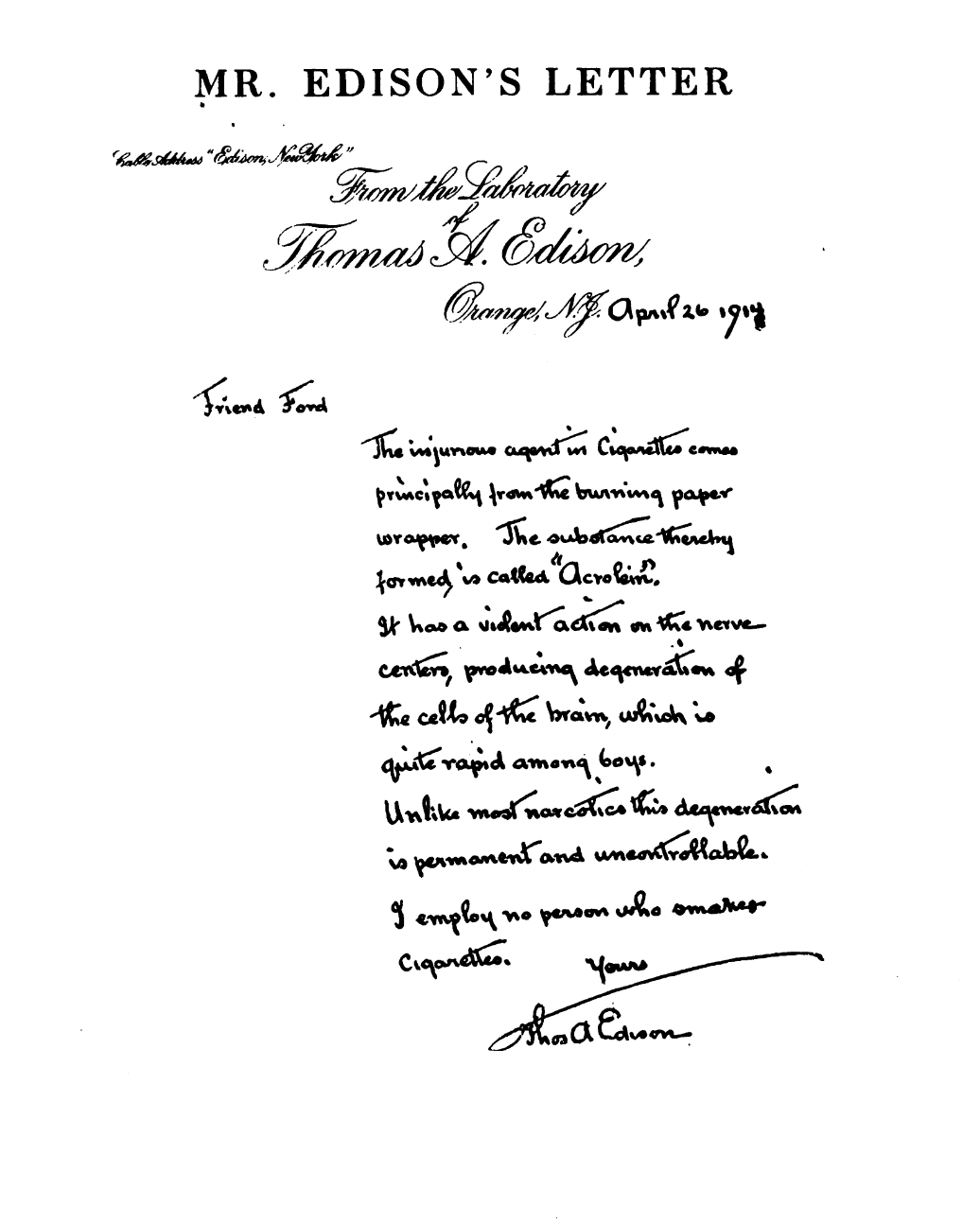
The book opens with this letter from Thomas Edison:
Friend Ford
The injurious agent in Cigarettes comes principally from the burning paper wrapper. The substance thereby formed is called "Acrolein".
It has a violent action on the nerve centers, producing degeneration of the cells of the brain, which is quite rapid among boys.
Unlike most narcotics this degeneration is permanent and uncontrollable.
I employ no person who smokes Cigarettes.
Yours,
Thomas Edison
The next page is the letter from Percival I Hill, the President of the American Tobacco Company, where he complains about Edison and Ford's comments regarding the innocent, beloved cigarette:
The form of your statement is of a character that denies us an opportunity to demonstrate its falsity and to prove the harmlessness of our product in a court proceeding. If you see fit to make a statement of the harmful effect of any of our brands, in such form that being false it is libelous, we will be delighted to institute suit for damages, and will devote the proceeds to some designated charity.
The scientific facts are all in favor of the cigarette, and no man can change these facts because he personally prefers a pipe to a cigar ... or a chew of plug to a cigarette.
It is extremely funny to me that someone can say "you haven't libeled us, can I ask you to do so so we can respond?" And also: I had initially assumed this book was about the dangers of tobacco, but it seems like maybe it is literally an argument about whether cigarettes are dangerous vs pipes and chewing tobacco? The past is a foreign country, truly.
(The rest of the letter is just about how cigarettes have been tested by "the ablest chemists in America and Europe" and found to be "absolutely pure", plus various arguments from authority + the fact that many doctors and other respectable men enjoy cigarettes. Twelve million Americans can't be wrong!)
The next letter is a reply from Ford's secretary to the The American Tobacco Co. It's fun to remember how hard it was to know what anyone was talking about in 1914: the secretary has to start by clarifying that he doesn't know what's been in which newspaper.
The letter is... not actually convincing, it just says that 1) smoking a lot of cigarettes is bad, 2) "young men addicted to the cigarette habit seldom if ever lead in their studies", 3) "99 per cent of the boys .. who come before [a certain magistrate] charged with crime have their fingers disfigured by cigarette stains." Come on Henry['s secretary], we can do better than this! I know you're trying to look out for "the benefit and uplift of our wayward lads", and history has vindicated your position, but a bit more rigour in the process would be appreciated.
The rest of the book is letters like this one from various doctors, educators and other experts:
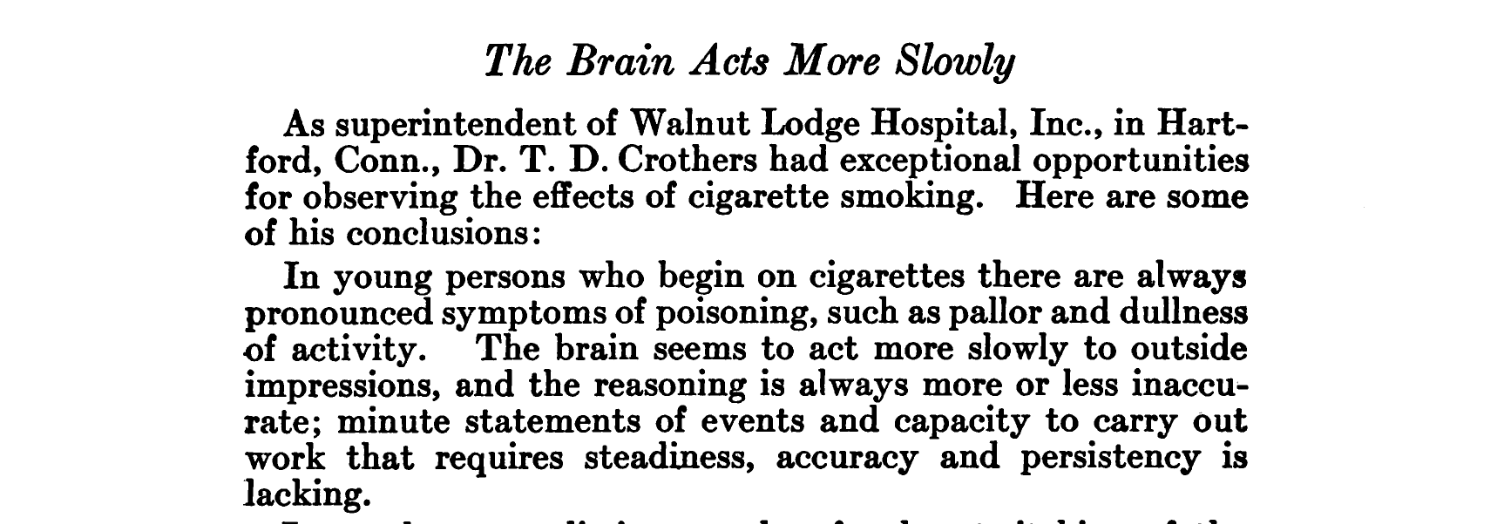
It feels like what they're describing is inebriation? I'm curious if cigarettes were different then, or the people involved were also drunk, or if what they're describing is actually cigarette withdrawal, or... some other explanation, hit me in the comments please.
There's also a couple of letters which give a glimpse of how research/statistics/science worked back then, e.g.:
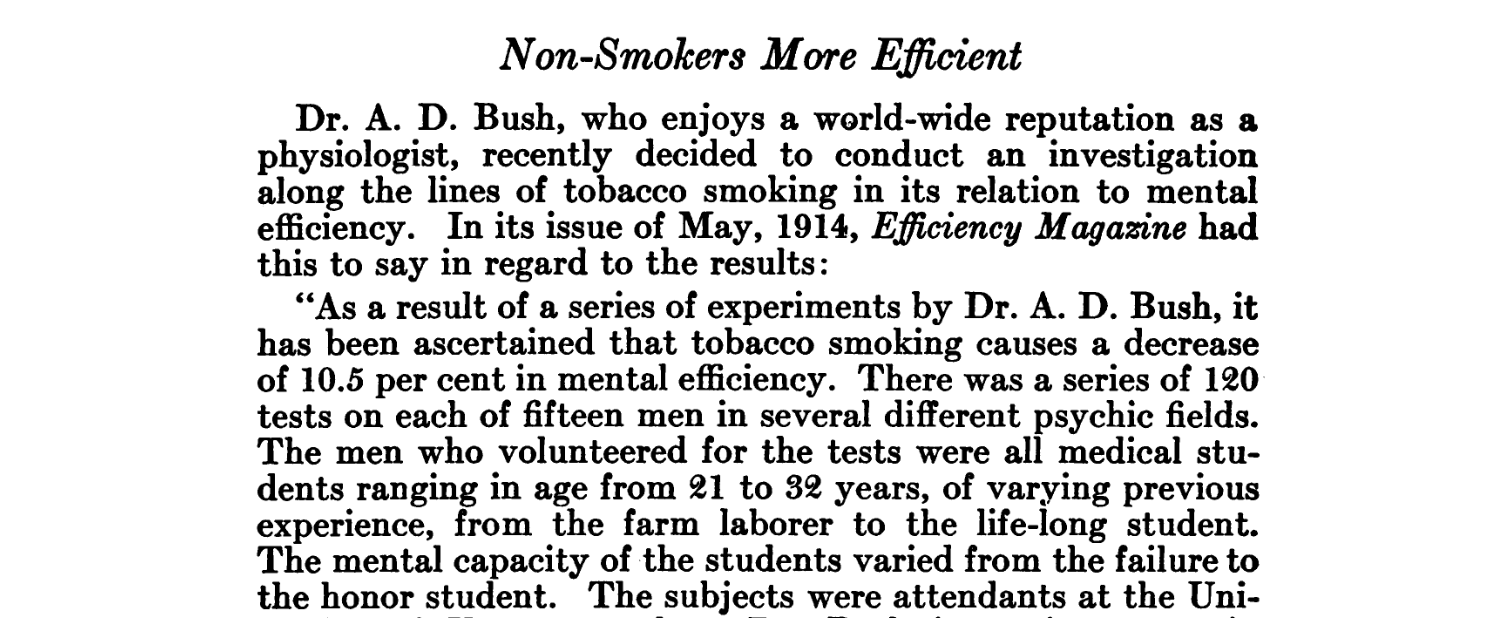
Later, a football coach writes in to say that 65% of non-smokers but only 33% of smokers were successful at football tryouts. I found this interesting because I'm extremely curious how people approached this kind of statistical work in 1914. Randomized controlled trials were only invented in the 1920s, right? How did this kind of "let's survey 210 people and announce the results as percentages" stuff feel to people in 1914?
(Obviously it's plausible that smoking makes you worse at sports, but also plausible that the kind of person who smokes is less likely to make the first team anyway – did people realize that in 1914? I guess most people don't really understand it today, so....)
Similarly, the president of the Georgia Woman's Christian Temperance Union – "a woman of exceptional mental attainments", we are told – writes in about an experiment she ran:
I took two small bottles, each holding about three tablespoonfuls of water. In one I placed 15 of these cigarette papers, and in the other an equal thickness of leaves of tissue paper from between visiting cards, for the tissue papers were much thinner and it took a larger number of leaves.
I found that a few drops of the water from the bottle containing the cigarette paper would kill a mouse quicker than you could say ‘Jack Robinson,’ and a teaspoonful of the water from the other papers seemed to cause a mouse to suffer no inconvenience.
I have killed dozens of mice with this water and there are others who have tried the experiment with the same success. Will Mr. Hill please tell me what made the difference in the same water, in the same kind of bottles, except the papers that were placed in the bottle?
I mean truly, what an age of science – have you ever seen a letter like this in a modern magazine? (Maybe there are, I don't read many modern magazines!) I would dearly love to read something about this spirit of experimentation in 1910s America.
(A later letter-writer speaks of injecting tobacco-juice under a cat's skin; "in less than twenty minutes it died in violent convulsions. I take no pride in relating this experiment, for I knew a shorter as well as a more merciful way of ending the cat's life; but what distresses me now is the fact that thousands of boys are repeating that experiment upon themselves with as certain though less immediate results, and only a few people seem to be concerned over what is taking place right before their eyes.")
One doctor writes a letter saying that tobacco causes a "dissipation [in] sense gratification.... the sedative action which it exerts upon the nervous system... steals away a young man's vigilance and alertness and handicaps him in the struggle for success. The use of tobacco paves the way to other dissipation by requiring a compensating stimulant to overcome its sedative effect." Am I reading into this with modern eyes or is that a pretty subtle understanding of how neurotransmitters work?
Various writers describe cigarettes as a gateway drug to alcohol, and then to morphine and opium.
A lot of the letters equivocate between cigarettes specifically, smoking more generally (including pipes), and other kinds of tobacco products. I think you'd need to actually understand the debates of the era to know what's going on here, and I don't.
There follows an excerpt from the London Lancet medical journal talking about the danger in cigarettes from "aldehydes." (The "acrolein" that Edison blamed for cigarettes' harmfulness is an aldehyde, and so is formaldehyde, but so is vanillin, and so is glucose – it's clearly a large category and I'm out of my depths assessing this). I guess a good reminder that there's a lot of steps between figuring out that something is bad for you and figuring out exactly why.
Connie Mack – GM of the precursor to the Oakland A's – is one of several people who basically writes in to say that smokers amount to nothing, ever. "It is my candid opinion, and I have watched very closely the last twelve years or more, that boys at the age of ten to fifteen who have continued smoking cigarettes do not as a rule amount to anything. They are unfitted in every way for any kind of work where brains are needed. No boy or man can expect to succeed in this world to a high position and continue the use of cigarettes.”
Hudson Maxim, an inventor of explosives who was apparently very famous at the time, wrote: "The wreath of cigarette smoke which curls above the head of the growing lad holds his brain in an iron grip which prevents it from growing and his mind from developing just as surely as the iron shoe does the foot of the Chinese girl." (I don't think Chinese footbinding actually used iron?) "With every breath of cigarette smoke they inhale imbecility and exhale manhood.... The yellow finger stain is an emblem of deeper degradation and enslavement than the ball and chain." (I include this just for the prosody).
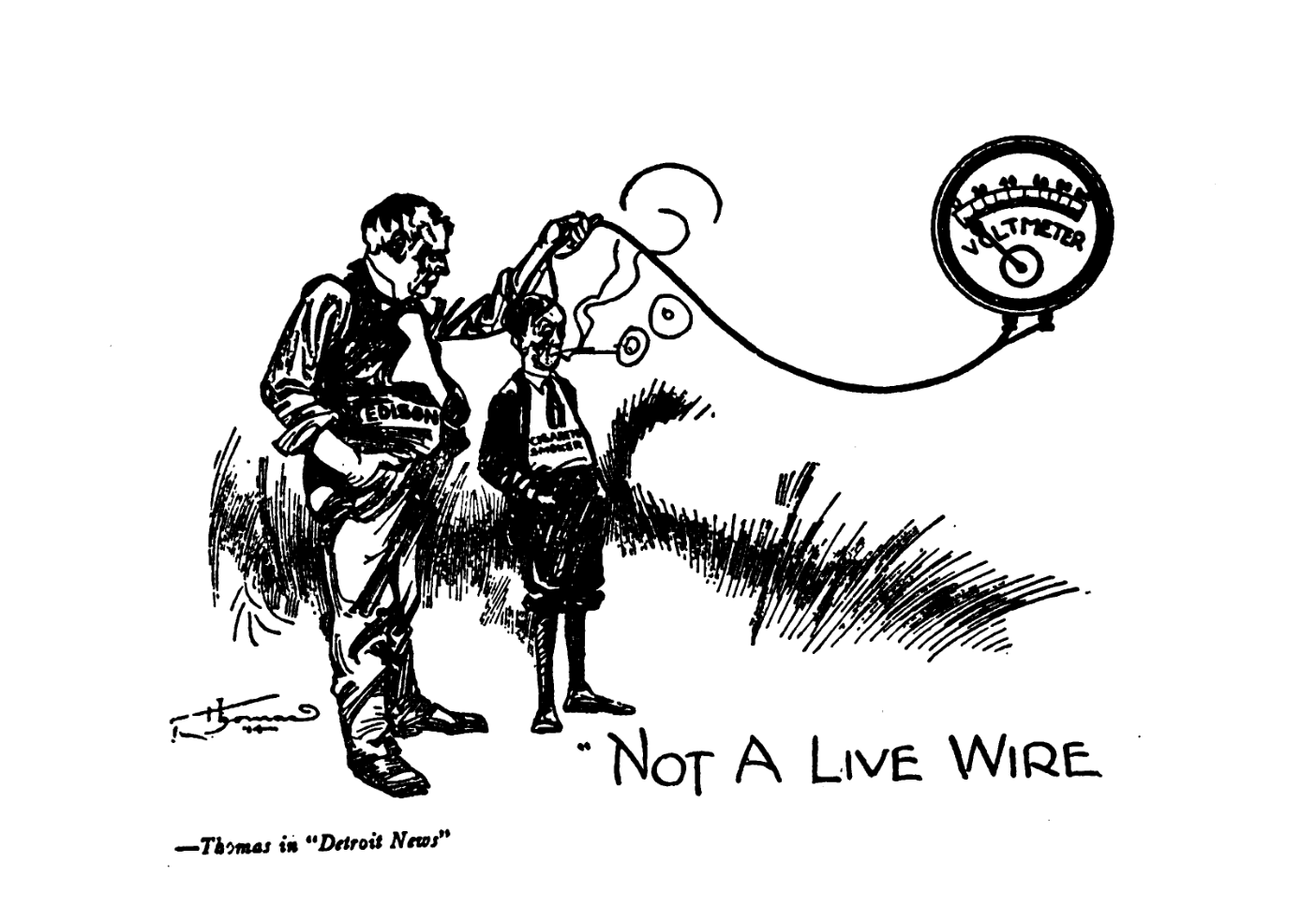
The book continues with Volume II, and this comic from the Detroit News, which I'm including only because it's funny how long newspapers have been doing this kind of unsubtle commentary via labelled characters and illustrated puns – that's Edison on the left, and a schoolboy Cigarette Smoker in the middle.
Volume II is about the "economic" side of smoking. Says Mr Ford:
Let us see whether you as an ambitious American boy can afford to ruin your prospects by doing those things which are disapproved by employers generally, and which in many, many cases must put you out of the running entirely.
If "millions of American men have convinced themselves that cigarettes are good for them" they have not succeeded in convincing their employers of this fact, and this is especially true as regards boys. I want you to read the expressions of opinion from some of the large employers of the country.... I know that you will then be in a position to judge for yourself whether you can afford to take chances on losing everything, and I am willing to leave the decision in your own hands.
It feels like a weird avuncular threat from the great industrialist of the age, no? I can't tell how much he means it to be a threat.
There follow a bunch of letters from big companies about how they don't want to employ smokers, e.g. from Cadillac Motor Car Company: "Boys who smoke cigarettes we do not care to keep in our employ. In the future we will not hire anyone whom we know to be addicted to this habit..... We made a study of the effect upon morals and efficiency of men in our employ addicted to this habit and found that cigarette smokers invariably were loose in their morals and very apt to be untruthful, and were far less productive than men who were not cigarette smokers.... We are proud to say that none of the prominent or executive men in this company use cigarettes."
After that there's a bunch of letters about how smoking reduces the moral, physical and intellectual qualities of a worker. (I was surprised mainly at the intellectual part, it does truly seem they thought smoking was bad for your brain). There's also a lot of claims to the effect that NOBODY who smokes has ever succeeded at anything, which seems like a bananas thing to claim, though I do get it's possible that cigarettes in 1914 contained heavy metals (or something) and really did dull the mind.
I was interested how many companies claimed that either they don't hire smokers or at least preferentially hire non-smokers. I wondered if this would be legal today, and it turns out 29 US states have "smoker protection laws" that prevent discrimination against smokers, but in the other 21 you can discriminate against smokers even if it's outside work and irrelevant to their job. (For extra credit, readers can guess if it's Democrat or Republican states that protect smokers' rights – it's not obvious which way it would break, right?)
The book ends with this (presumably made-up) story about a smoker and a non-smoker, which I honestly really enjoyed. Initially they are both rising stars in the journalism business, "two fellows whom to know was to like":
I shall not mention their names. That would be revealing identities that might better not be disclosed, for the sake of both. Neither shall I sketch the two careers too intimately. If I did it is more than likely that even in his pitiable mental state the one would recognize the portrait of himself, and there is no desire on my part to add one jot to the mental anguish he must suffer when in the few lucid moments he is permitted he looks back over opportunities that were worse than wasted.
One offers the other a cigarette, and is rebuffed.
"Ha," laughed the political writer, jokingly, "you have no small vices, eh?"
The reporter looked grave.
"I am not sure that is such a small vice," he replied slowly.
Not to be a spoiler but the non-smoker becomes a journalism superstar in New York while the smoker devolves into a life of farm labouring, then lumber shoving, then panhandling and potato peeling, all due to his crippling addiction to cigarettes.
Overall, I found this book a weird and interesting lens into a time gone by, and at 46 pages long it's not too heavy lifting (ok: admittedly at this point in my life even 46 pages is non-trivial, but relatively speaking).
It was also a source for many fun rabbit holes about once-famous people like Mack, Maxim, and "Luther Burbank the wizard of the plant and vegetable kingdom, whose experiments have caused the civilized world to wonder." I wish more books like this existed.
I wish I understood more of the context of the time and how the debate about cigaretttes worked, and (even more so) why smoking took almost a century longer to phase out.
I inevitably also found myself thinking about my own self-damaging compulsions: I've written before that I feel like modern phone use will someday be seen at-least-partly analogously to cigarettes – movies will show couples in the 2000s in bed on their phones, and people will think how did you live like that? – and this book gave me an odd, knowing feeling that it will be easy to compile a book of similar quotes about how phones are frying us, and that (like cigarette smoking) we're going to keep doing it anyway. It's not that simple, but it is, and also it isn't.