Emotional Literacy
guest post!
A guest post from friend of the blog Kester
If you want to think about something complex, it really helps to be functionally literate. I mean "literate" in the most obvious sense: can you read and write? Do you have access to a pen and paper, or a keyboard? Take a grocery list, for example. Without the tools of literacy, I could probably maybe remember 7 items I want to buy...well ok maybe more like 5. Or 3 items to be perfectly honest. But with literacy, I can externalize my memory onto a piece of paper and access a grocery list that is much, much longer. I can even add recipes I copied from someone else's literacy, nutrition facts, poetry about plums in the icebox, etc. From there, you create all of civilization.
Letters aren't the only form of literacy. With the literacy tool of Arabic numerals, you can create an external workspace where you do long division, billable hours, and complex physics calculations. With visual literacy, you can read a bar graph or a street sign or a subway map. That subway map is a literacy tool that creates an external workspace for comprehending complex spatial problems. As you examine the subway map, your thoughts enter that workspace and follow along the lines that someone else drew, and you compare that information to your own experience of the city. You apply your information to the workspace, and the workspace in turn informs you of other possible experiences. This is literacy--participating in a shared external workspace.
So here is my question: if we use literacy to create shared workspaces for cooking and storytelling and physics and subway systems, why don't we have a shared workspace for understanding human emotions? Is there something about emotions that is inherently illiterate?
About ten years ago, I was a teacher at a school for neurodivergent teenagers (kids with ADHD, Autism, dyslexia, etc). One of our goals at the school was to increase our students' "emotional literacy". This is a worthy goal because when teens understand and can talk about their emotions, they gain self-awareness and calmness, and they can better advocate for their own needs. If you aren't aware of your negative emotions, they tend to blindside you and drag you down. And if you aren't aware of your positive emotions, how can you check to see if a situation is working for you?
The problem is, most adults expect teens to be able to spontaneously talk about their emotions off the top of their heads. They're teens, they have big feels, right? So they should be able to talk about them, right? But most teens can't do this! They just say that they are "ok" or "tired" or *shrug emoji*
In my opinion, asking teens to sit at an empty desk and talk about their emotions is like telling them they can only do math problems by intuitively understanding numbers and keeping track of them in their heads, without paper or pencils or formulas. Some incredibly gifted kids CAN do math in their heads, but it would be crazy to teach math as if everyone had that ability. So why were we asking these students to do the same thing with emotion? These kids needed an external workspace to label and understand and mark down emotions. These kids needed a subway map for emotions.
The emotional literacy materials that were available at the time left me deeply unimpressed. Most emotion charts are either for very small children or they are visually overwhelming and disorganized word salad. Surely, I thought, surely it is possible to think about and organize emotions logically and clearly? I just didn't believe that emotions and rationality were inherently opposites. As they used to say in '90s infomercials, "There's got to be a better way!!"
So I decided to make my own emotional literacy workspace, called the Emotion Awareness Board. (kesterlimner.com/emotion) The map is organized by type and intensity of emotion, using color and spatial orientation. Originally, these were printed on magnet boards so my students could hold them at their desks and mark multiple emotions with little magnetic game pieces.
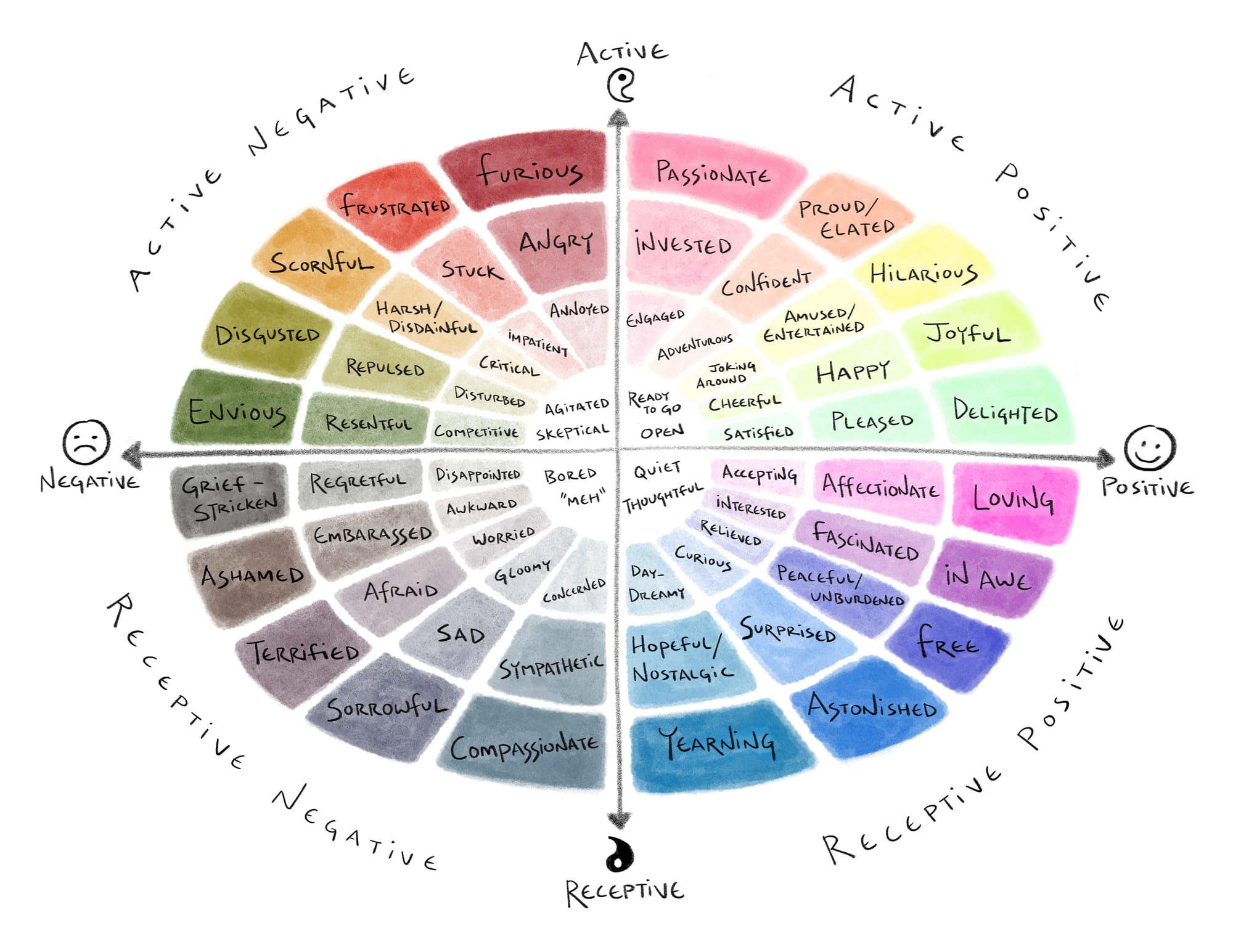
Being able to mark multiple emotions at once is the most important aspect of this external workspace. For example, perhaps you are nervous and curious at the same time. You might be joking around, but also frustrated and critical. You might be embarrassed and proud simultaneously. Or maybe you are pleased and affectionate with a touch of jealousy and regret. Just like with a recipe or long division, it's so much easier to think about these complex states when you have an efficient way of notating them!
Once they had access to an external workspace, all of my students immediately had functional emotional literacy. Even the grouchiest Autistic teens in my class were willing and able to share three or four feelings they had experienced over the weekend, and talk about why they had felt that way. Maybe it's because they now had a workspace that made sense to their brains, or maybe it's because the Emotion Awareness Board was a physical invitation, a talisman that grants permission to speak (or a functional way to indicate things non-verbally, if starting with speech was too challenging.)
I designed this one tool for my students, and I think it's pretty good, but I don't think it's necessarily the best tool for all people or cultures. I just think there should be SO MANY MORE tools out there to help us understand how we feel, so that we can make better life choices and care for each other more effectively.
Literacy produces all of civilization, full stop. So, if we believe human flourishing should be the next frontier of civilization, we're going to need some emotional literacy tools to get there.
Ok, here's some questions for potential commenters: Do you have any other literacy tools to suggest? Charts and diagrams? Is poetry a literacy tool? Book quotes? Memes?!?! If so, which ones have been helpful for you? Does a literacy tool have to be participatory (read/write function) or is just receiving information enough?
Further questions: Do you have a "default" emotion that you feel most often? (mine are curiosity and annoyance!) Are there emotions you don't want to admit having, but you have them anyways? Is talking about emotions inherently embarrassing? If so, why??