Three Models Of Love
your model determines your dating choices
I think implicitly there are three models of love:
Model 1: you can be equally happy with a very wide range of people – you just need to spend time and grow together.
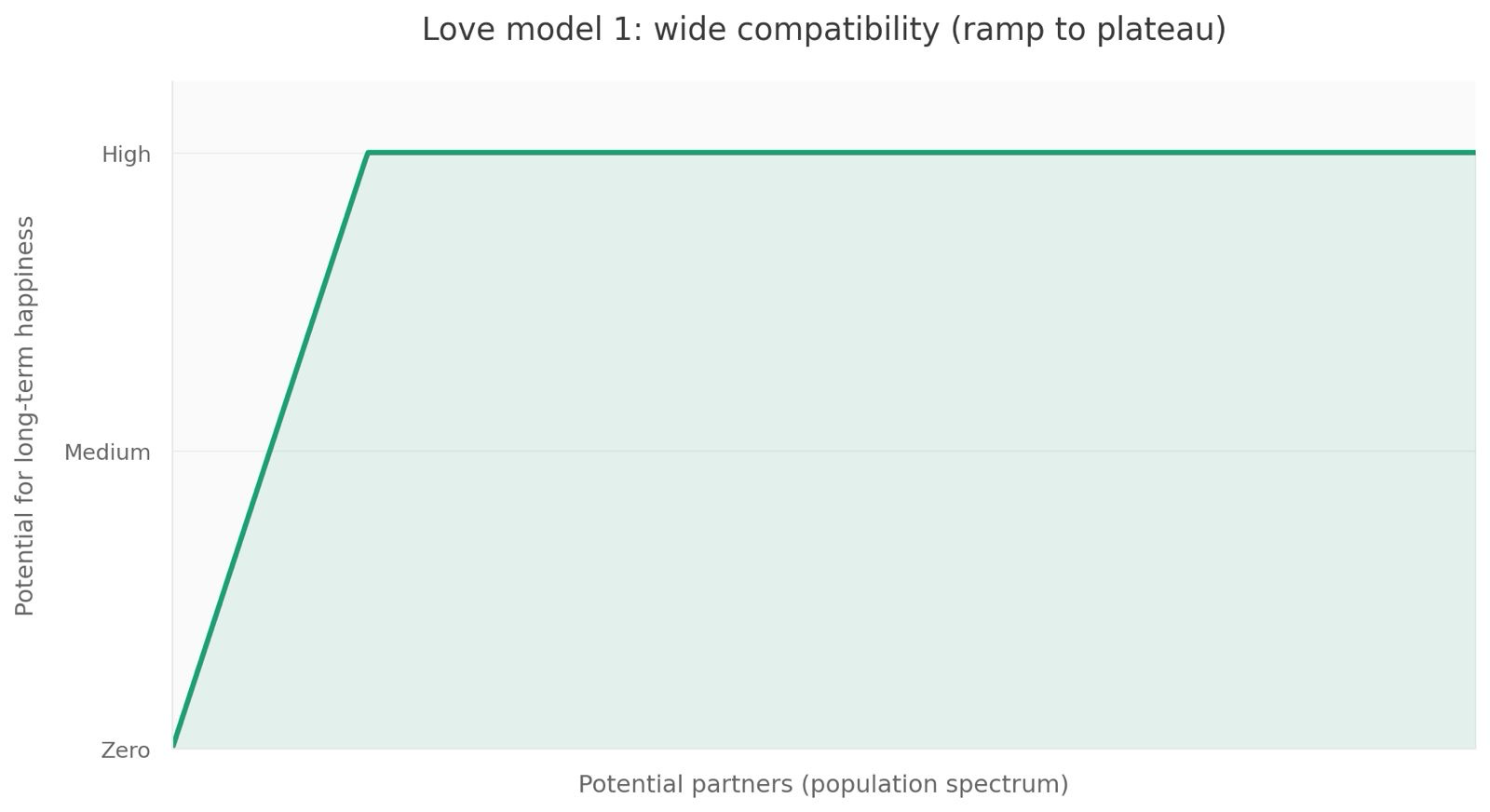
I think this is the implicit model behind arranged marriages: as long as you pick someone within the (large) pool of people you're basically compatible with it doesn't really matter who it is, you should just settle down with the first reasonable match you get and then do the work of growing to love each other.
(This surely varies by culture, but my understanding is that most modern arranged marriage cultures don't just say "you have to marry THIS person", you get offered matches and you're allowed a couple of "nos" before you say yes. Except that you know that if you say too many "nos" you'll be branded as difficult, so saying "no" is risky. But still, I think this matches the model described above: you're expected to act as if 50%+ of people in your pool are reasonable matches, but you don't have to act like 100% of the pool is good enough).
Model 2: there's a normal-ish distribution of how happy you'll be with different people: some people you'd be very unhappy with, many people you'd be vaguely-ok with, some people you'd be very happy with.
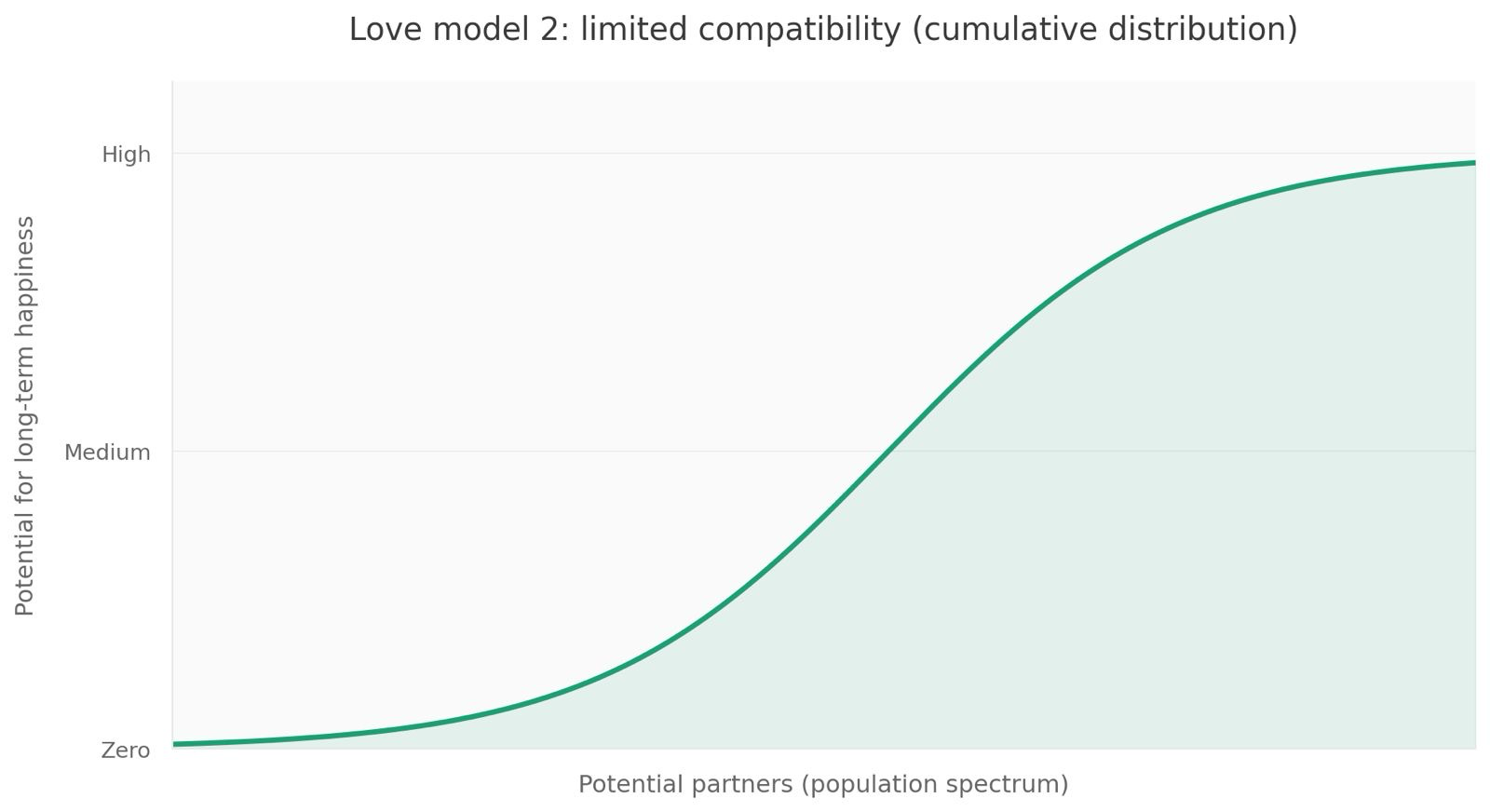
With a normal distribution the tails are very light. Imagine lining up 100 people in a row from the person least-compatible to most-compatible with you. The amount of benefit you get from going from the 50th-best person to the 20th-best is the same as the benefit of going from the 20th-best to the 5th-best, and the same as going from the 5th-best to the 2nd-best (roughly).
But the difficulty of getting that improvement increases each time: it's 2.5x harder to find the 20th best than the 50th best, and 4x harder to find the 5th best than the 20th best, and 8x harder to find the 2nd best than the 5th best.
Unlike the first model, it doesn't make sense to marry the first random person you meet: you really will be happier with your 5th-best person than your 20th-best. But if you're already dating your 5th-best, is it really worth holding out to find your 2nd-best? It depends on your values but I would argue "probably not", given the search costs and the risk of ending up alone.
I think this is, ultimately, the model that most modern WEIRDos have about dating, but would be interested to hear if you think otherwise.
Model 3: There's an extremely fat-tailed distribution of how happy you'll be with different people: the best person for you is meaningfully better than even the second-best person, let alone the 5th-best.
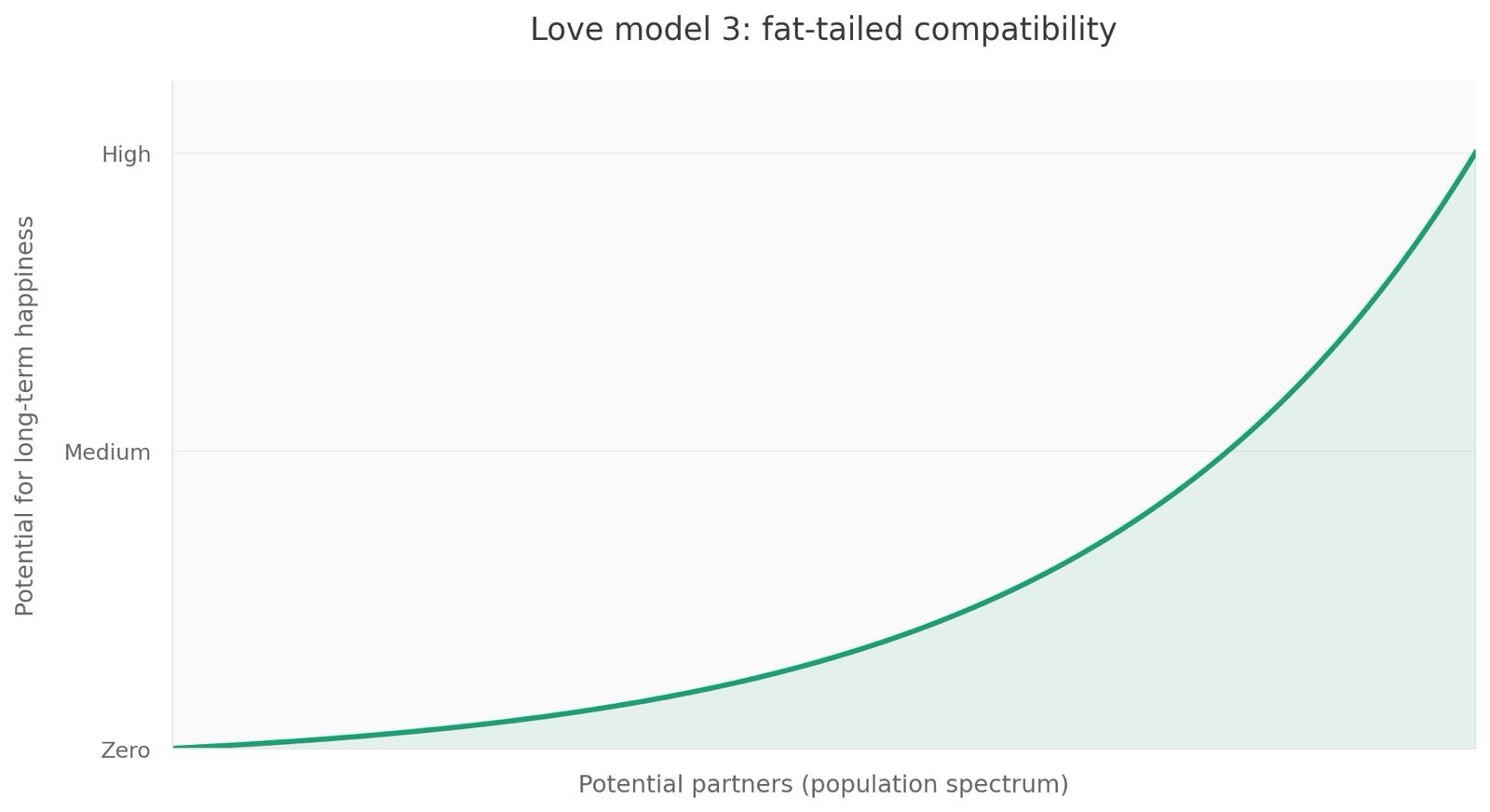
This is the "soulmate" or "one true love" model of relationships. Depending on the numbers, it probably does imply that even if you're currently dating the 2nd-best person for you, it can be worth the trouble to break up and keep searching for the 1st-best, because the happiness that awaits you is beyond comprehension.
The three models have very meaningful implications for how you should live your dating life: from "marry the first person you meet within the top half-ish of your distribution" to "probably hold out for someone 90th percentile or above, but don't fret about getting 99th" to "it is actually very important whether you marry your 99th percentile or 99.9999th percentile person, good luck!"