Thoughts About Intrusive Thoughts
guest post!
Nowadays, if you have a baby, you can get all the baby supplies delivered to your doorstep, but back when I had my kid in 2004, you had to actually leave your house and go to Target.
My friend had a baby around the same time, and both of us lived near an urban Target superstore in North Seattle. This Target has a strange architectural feature: an outdoor pedestrian overpass bridge from the top of the very tall parking garage to the main entrance of Target. This walking bridge was about 7 stories off the ground! I've never seen another Target building like this, and I hope it's the only one, because it's awful.
So, imagine you are a new mom holding a baby. The only way to get from your car to Target is to carry your tiny baby across this windy, exposed catwalk with transparent barriers that are lower in height than the baby in your arms. (The walkway is actually quite wide, so it's safe if you stay away from the edge, but the optics are disturbing.)
One day, my friend confessed to me that she had been having terrible intrusive thoughts, imagining what would happen if she somehow dropped her baby over the edge of the Target bridge. At the time, I offered all my sympathy, and tried to be a good listener and a good friend. But I honestly didn't know what to think, because I also had these exact same thoughts!!! The difference was that the thoughts didn't bother me very much. For the last 20 years I've been trying to understand why.
Holding my baby while walking on the Target overpass, an image came into my mind about what would happen if he somehow fell over the edge. My brain started imagining the sight, the sound, the horror, the consequences. (I could go into detail, but I won't, because the image is genuinely upsetting.)
But then I had these thoughts about my thoughts:
I thought, "Wow, my brain is doing a great job warning me about danger!"
I thought, "It's a good thing I'm imagining this so viscerally so that I can be sure to avoid it."
I thought, "Ha, I'm such a good mom that my brain is coming up with ridiculous danger scenarios."
I thought, "I bet a lot of imaginative moms have experienced the same thing."
I thought, "Whoever designed this Target building is the worst!!!"
When my friend walked across the bridge, she had the same image in her head of dropping her baby--the sight, the sound, the horror, the consequences.
But her thoughts about her thoughts were different.
She thought, "Something very bad is happening in my brain right now, and I'm helpless to avoid it."
She thought, "It's terrible that I'm imagining this so viscerally. Only a bad mom would imagine this."
She thought, "My baby is in danger, because I'm starting to lose my mind."
She thought, "Something bad happened to me in my past, and now I'm broken forever. If I tell anyone, they will know how messed up I am."
She thought, "I'm the worst."
My friend was definitely suffering from intrusive thoughts, but I think the biggest intrusion wasn't her original thoughts, but her thoughts ABOUT the thoughts.
We can make a chart like this:
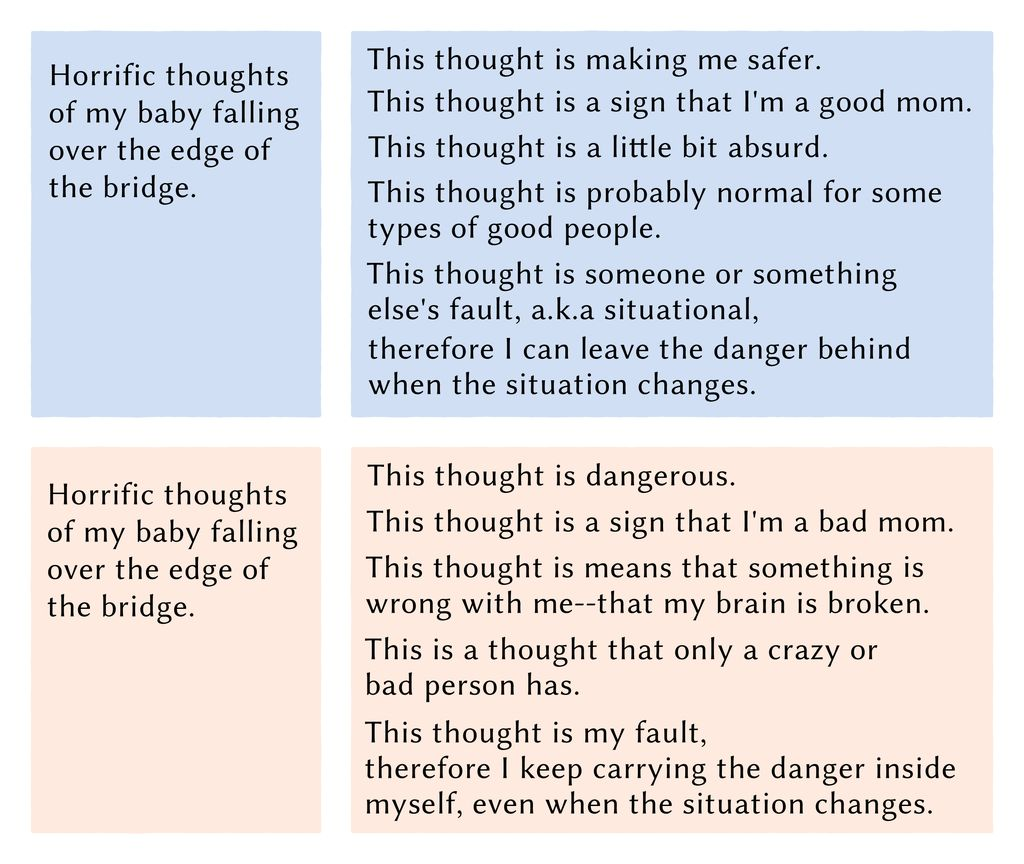
That last point is the real kicker! Our brains are designed to be vigilant during danger and then to relax that vigilance when the danger is passed. But if you perceive your own thoughts to be a danger to you, then there is never an opportunity to relax--you get stuck in what I call the threat cycle. You can never let down your guard.
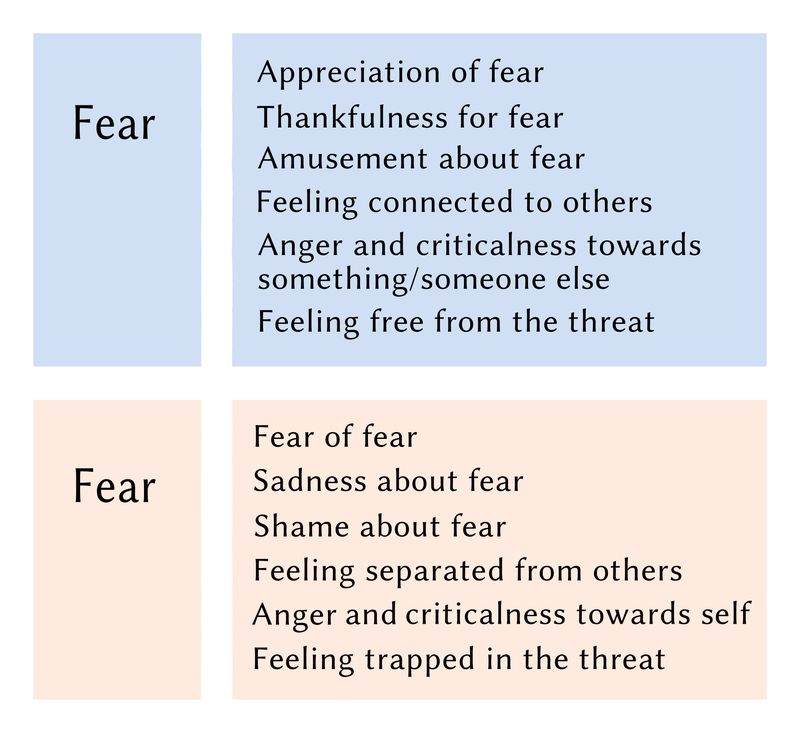
Just like you can have thoughts about thoughts, you can also have feelings about feelings. For example, you could get enjoyment from something, but also be embarrassed that you enjoy it (a.k.a. guilty pleasure). You could feel grief, but be angry that you have to grieve. You could be annoyed, but actually find it funny that you're annoyed.
Let's rephrase this Target pedestrian bridge situation in terms of emotions:
The Solution
The next logical question is, how do we change our thoughts about our thoughts? Changing our thoughts must be the secret to avoiding suffering and becoming awesome, self-actualized superhumans, right??? Let's hack our brains and become invincible through the power of positive thinking!!!
Unfortunately, I don't think this works. I don't believe you CAN change your thoughts, or your feelings! (See: Emotions Are Reactive) Thoughts and emotions arise spontaneously and you can't delete or change them: it's the "don't think of pink elephants" problem. Or if you're Gen Z, it's like "the game" where you lose whenever you think about the game. The moment a thought arises, it has existence.
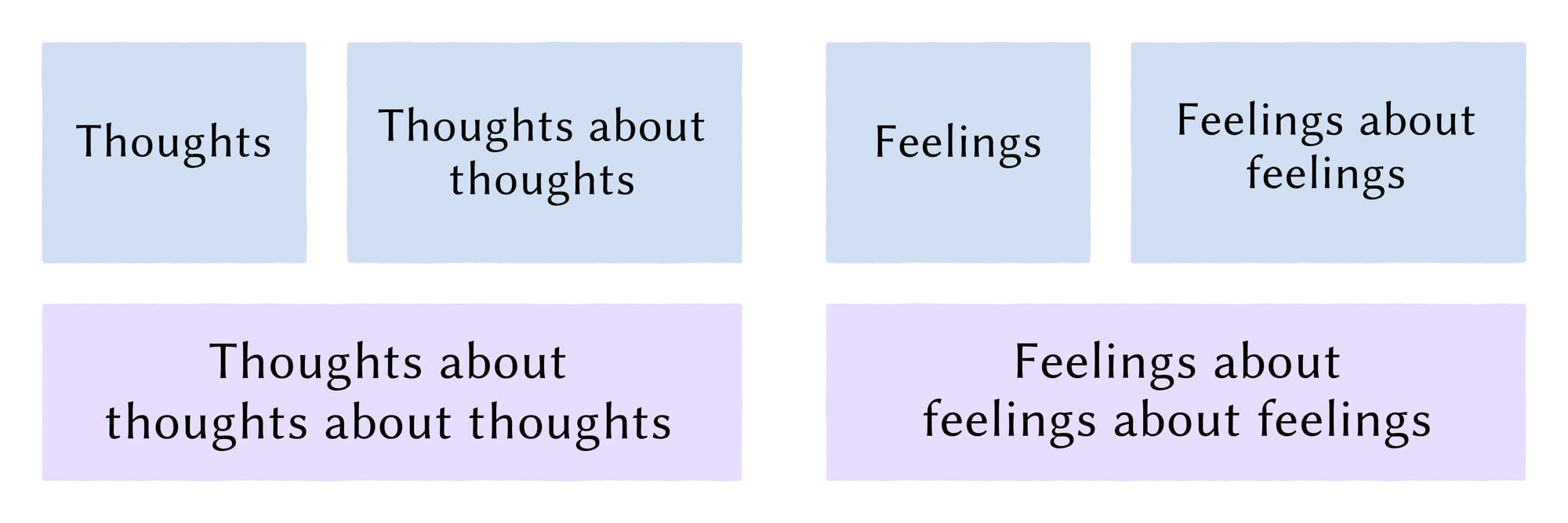
However, although we can't prevent or alter our thoughts, we might be able hold them within another layer of rationality or compassion. So we need a third tier:
But here's the one weird trick, the actual solution to the problem: it's best if that third tier comes from ANOTHER PERSON.
This is called co-regulation.
Here's what happens when you invite a basically kind, trustworthy friend into your situation and allow yourself to co-regulate with them:
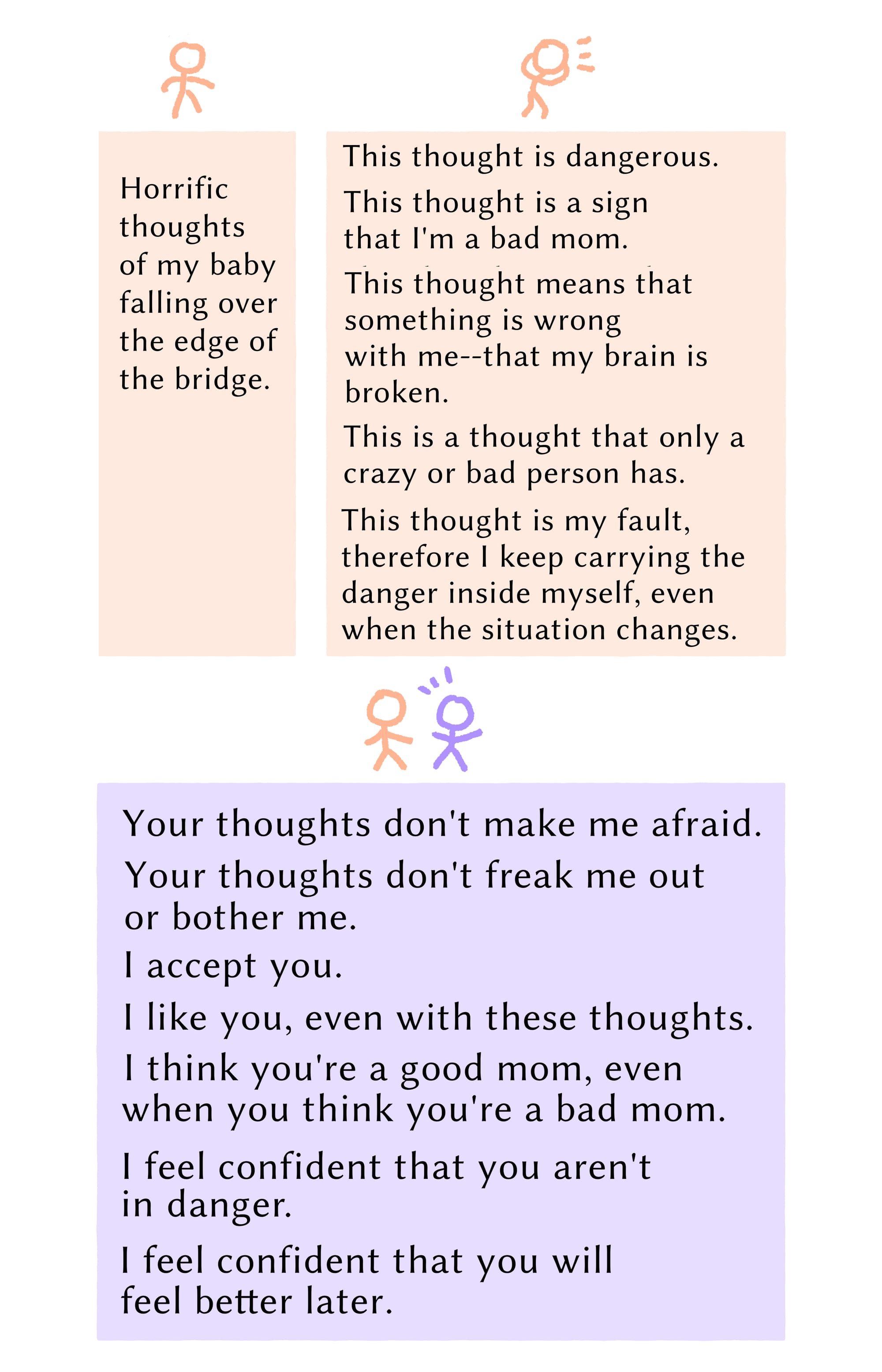
If you have another person alongside you, you can observe that your fears and thoughts are not as scary to them as they are to you. This is the best way (and possibly the only way) of breaking the threat cycle.
Co-regulation doesn't require the other person to have a therapy degree or do any special techniques. It just requires physical presence and a little bit of affection and trust--the amount you would normally have in a positive friendship. That's because basic co-regulation works best when it's not a huge effort for the other person.
Let me put it a different way: the best person to co-regulate with is NOT a person who wants to delve into the deepest parts of your psyche. It is NOT a person who is extremely, personally invested in your mental health (This is why parents and romantic partners tend to be bad co-regulation partners; they have too much skin in the game.) The best person to co-regulate with is someone who likes you, and yet your problems are genuinely not that big of a deal to them! Just a regular friend who wishes you well and isn't bothered by your thoughts.
And check this out--the best part about co-regulation is that the friend doesn't need to even say anything or do anything! The process can be entirely nonverbal. They can simply be standing next you, not being terrified, basically trusting you and being basically trustworthy.
The reason physical, nonverbal presence works so well is because humans evolved as social primates. Co-regulation is pack behavior. Your little monkey brain is looking for conscience and subconscious social cues from other monkeys to let you know that you are safe from danger, and can relax your vigilance. Positive co-regulation with our monkey buddies is how we evolved to keep ourselves safe AND curious AND brave. Social support is our evolutionary superpower.
Obviously, there are other emotional and spiritual models for understanding co-regulation, but I think the monkey model is a great place to start. Monkeys just need other monkeys around to feel safe and be happy!
Objections to co-regulation:
"A mature person is self-sufficient and doesn't need to rely on other people."
NOPE. A mature person is one who has strong, positive relationships with friends and family members. Self-sufficiency is a 20th century lie that makes us lonely and miserable. Next objection please.
"If my therapist says supportive things to me in our sessions together, I should be able to remember those supportive thoughts later when I am in the stressful situation."
Ugh, I know, right? I wish this strategy worked! Sometimes it does, but often it does not. Our monkey brain responds much more easily and fully to someone who is physically present in the present moment. Your therapist is there to offer co-regulation when big emotions come up during your sessions. And, that supportive relationship can help you recognize what kindness and stability feels like, so you can start finding it in other people. In other words, therapy is great, but it's not a substitute for in-person daily-life co-regulation; it's more like training in how to recieve it.
"I don't want to ask my friends for co-regulation because I don't want to be a burden."
Yes, this is a huge obstacle!
A lot of people keep their thoughts and fears private, and don't reach out to friends, because they're afraid of dragging others down, or asking for "too much." But this type of support can be fully reciprocal, and EVERYONE needs co-regulation with something! Fear requires co-regulation, but so does boredom, distraction, hesitation, and discouragement.
If you're worried that asking for help might make you a burden, offer a 1-to-1 co-regulation swap! Ask your friend to come with you to a scary doctor's appointment, and then offer to sit in the room with them while they clean out their closet. If you pair asking for help with giving help, everyone wins.
Inversely, if you always find yourself in the helper role, try being more outspoken and clear about what you need help with in return, even if it's weird or small or random! Switching from giving help to receiving help can be humbling and vulnerable, so be gentle with yourself. Let your friends know that it's hard for you to ask, so that they can be gentle with you as well. As a bonus, this will lead to much deeper, more sincere friendships.
"I don't have any friends."
OR
"All my friends and family members are jerks and/or emotionally unstable."
Oh no, I'm sorry! Making friends will have to be a blog post for another day. For now I would suggest practicing co-regulation with friendly acquaintances, coworkers, and classmates. Just being around someone calm or cheerful can create nonverbal co-regulation, even if the relationship is not very deep. You don't have to excavate your deepest fears, just find someone with chill vibes and allow yourself to tune into their vibe. (I think this is the main reason why people work on their laptops in coffee shops.)
If you need co-regulation late at night when no one else is awake, listening to an audiobook or guided meditation can be a quick hack, because the narrator is reading in a calm, relaxed voice. This is a great place to start: https://self-compassion.org/self-compassion-practices/#guided-practices
The effect of the recorded human voice is not as powerful as in-person physical presence, but it IS always available.
Just as a caveat, I wouldn't reccomend watching videos on your phone for co-regulation, because having a single point of visual focus keeps your brain in vigilance mode. (This may be why using short form video platforms increases general anxiety rates.) With audio only, you can allow your body and eye muscles to wander freely and physically relax, which reduces vigilance, helping you exit the threat cycle.
OK, let's go back to that moment 20 years ago, when I was very young and not very confident. My friend told me about her intrusive thoughts, and I replied, "Oh no, that's so terrible, I'm sorry you have to go through that. That must be so hard." I think that was a sincere response, but not very helpful. I was just mirroring back her own fears that the situation was something to be afraid of.
Later on in my life, after I learned more about human psychology, I might have said, "Have you considered that intrusive thoughts are a symptom of OCD? Check out this great cognitive behavioral therapy workbook! https://a.co/d/08FwyxJB "
This approach CAN be helpful for some people, IF they are feeling otherwise socially supported, and are in a season of self-reflection and growth. But for many people in many phases of life, framing bad thoughts in terms of a "disorder" just reinforces the thought that says, "There is something wrong with me. My thoughts are dangerous and need to be fixed. This my fault." I believe that diagnoses and CBT are good tools, but only work in the context of community and good relationships.
Honestly, nowadays, I wish I could go back in time 20 years and say this to my friend:
"I love you! It's ok to feel this way! I have a hard time with Target too, because I always get distracted and lose track of time. So give me a call and we will meet up in the parking garage with our babies. We can hold hands and walk across the bridge together."