Pantoum Time
it is the time of the pantoum
For more than half my life, now, I've wanted to write a good pantoum.
It's bothered me for a long time that most of the famous pantoums in English are not good.[^1] This is in contrast to, say, the multiple phenomenal villanelles; I'm pretty sure I also read a good sestina once, but its identity is tragically escaping me now.
A pantoum is a type of poem based on the Malaysian pantun and with a very rigid repetitive structure: basically, the second and fourth lines of each stanza become the first and third line of the next stanza, and so on. This is the source of the difficulty: each stanza can only introduce two new lines, and those need to be re-usable in the next stanza, without (ideally) sounding either boring, vague or clanky in their new positions.
Readers who hate LLMs please cover your eyes/nose now:
I turned to Claude. "Write a pantoum" has been my personal LLM benchmark for a while now, and whatever developmental leap Claude went through earlier this year means she is now able to write a surprisingly passable pantoum herself.[^2]
But she also gave me two gifts to help me pantoumime on my own behalf. First, she – largely under her own direction – designed this Pantoum Editor that lets you easily see which lines need to match, and where you currently have mismatches, and realign them. I'm really impressed with this product, you can try it for yourself here: http://www.marbiru.com/pantoum-editor.
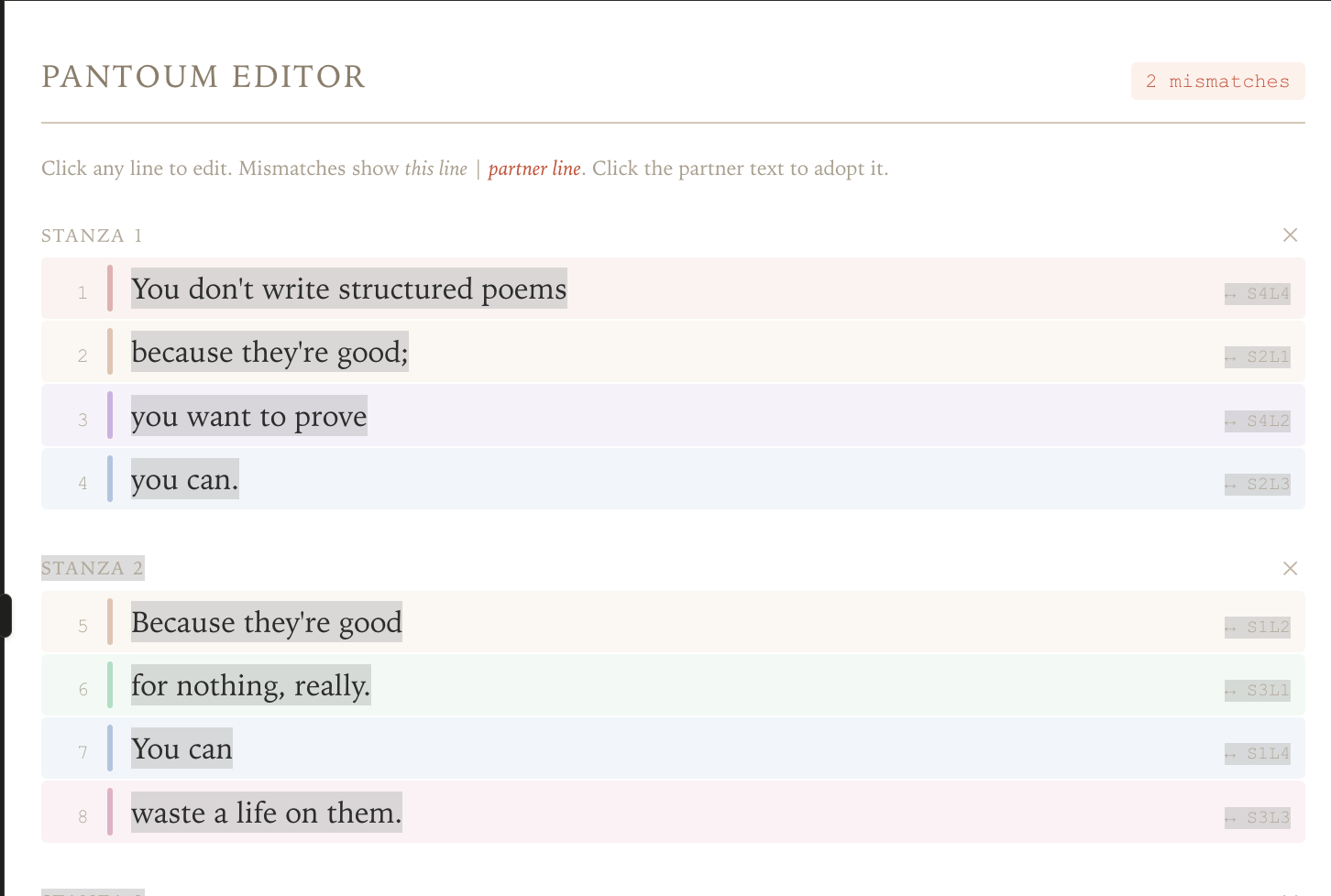
She also had the patience to argue with me as I crafted the following folly. The first line has been in my head for a decade now, and the writing is all my own, but Claude provided the thing that neither I nor any other human could give me in the meantime, which is some bundle of conscientiousness/structure/motivation to get the thing done. I'll write about this some other time, but I think in some ways it's one of the most interesting use-cases of Claude these days (however long These Days lasts): an enforcement mechanism for people who struggle to enforce themselves.
Anyhow! I do not claim this is the good pantoum I dreamed of, but it does exist, and I'm glad for that.
Structured Poems
You don't write structured poems
because they're good;
you want to prove,
you can.
Because they're good
for nowt – wish
you can
amuse.
For now. Twish!
You want
a Muse,
yourself.
You want,
you want to prove
yourself.
(You don't write).
[^1]: basically: the easy way to write a pantoum is to just make each line vague and mysterious and not entirely grammatical to begin with, then interlock them. You know the kind of thing: "the sky hangs heavy like a labcoat / oh, the supple summon of the waves / my heart beats merry merry every morning / the time of our beginnings is awake." Then the next stanza can start "Oh, the supple summon of the waves:", and then more of the same, and it doesn't make any more or less sense than it did before. This (I'm sorry) is basically what I think of John Ashberry's Pantoum, unless there's something there I'm missing.
Another trick for easier pantouming is to make the subject be something that justifies the repetition. E.g. I think Baby's Pantoum by Anne Waldman is quite good, but it leans heavily on the conceit.
Many English pantoumists have simply agreed you're allowed to bend the words of the lines so long as they're roughly the same. e.g. Parents Pantoum by Carolyn Kizer. I don't understand this, if you relax the constraint you've lost the challenge? (Baby's pantoum cheats a bit as well, I think, but not as egregiously. Also, I am much more sympathetic to cheating slightly after fully internalising how hard it is to do properly).
A big shout out to Nocturne by Sadakichi Hartmann, which I find very pleasing, both because the repeated lines somehow feel altered by their new positions, and because the theme (boats on the water) fits well with the waves of repetition to begin with. Imho this is the best existing pantoum.
[^2]: Tide Work, by Claude
The harbor keeps its ledger in salt,
counting what the moon has loaned the shore.
Boats come back lighter than they left.
Nothing stays where you put it down.
Counting what the moon has loaned the shore,
the gulls audit each retreating wave.
Nothing stays where you put it down—
even the rocks are smaller by morning.
The gulls audit each retreating wave,
patient as bookkeepers in gray suits.
Even the rocks are smaller by morning,
worn to the shape of someone leaving.
Patient as bookkeepers in gray suits,
boats come back lighter than they left,
worn to the shape of someone leaving.
The harbor keeps its ledger in salt.