One Art
no disaster
As you all know, I'm very interested in the question of whether it's possible to make true art with AI. (We all know it's possible to make slop with AI, but that doesn't determine whether art is possible too).
Many years ago I had a dream, or vision, of an egg breaking on a mountaintop, with the yolk as the sun. I always told myself that if I were an oil-painter this is what I would paint. And yet.... without the ability to sketch or paint it – and without even a strong enough visualization ability to explore it in detail in my own mind's eye – I never really explored it further. I didn't even fully imagine the image, what exactly it would be or look like.
I thought that now, with a new prosthesis, I might give it a go.
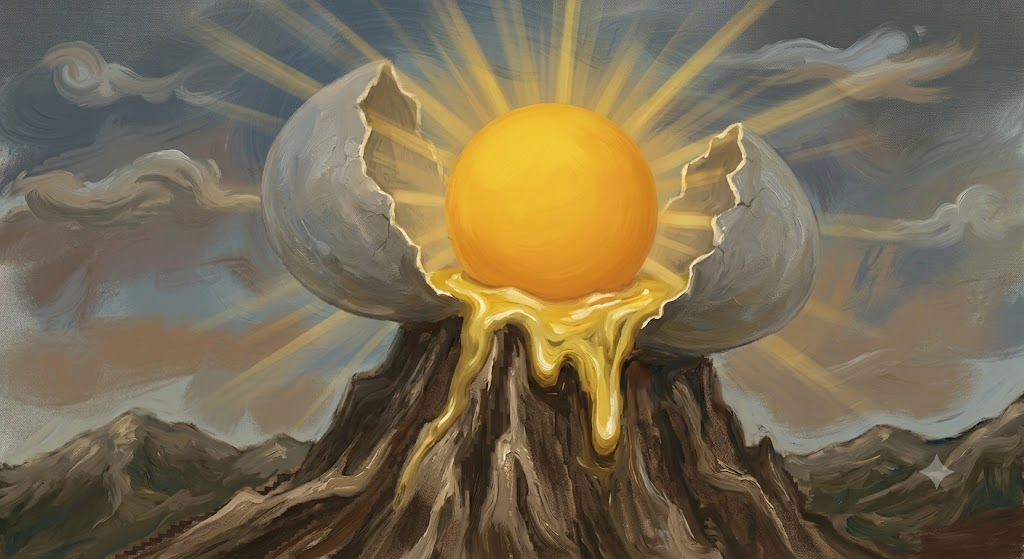
Is this art? To me I think the answer's yes: it captures something that was in my heart, and which I've never seen anyone else paint, and which I wouldn't know how to convey to another person in any other way. It's not quite how I wanted it, but if I painted it it wouldn't go quite how I wanted it either.
I don't know how it looks to anyone else, but then that's also the case for the (non-visual) art I make the old-fashioned way. And to me step one of "what is art?" might be: does this work make the artist feel something? There's a very long way to go from that to great art, but it's already not easy to get there: it's very possible to make things that mean nothing even to yourself. (Most AI images I see feel very clearly in that category).
A mentor of mine once told me your job isn't to make something good, it's just to make something true. I think this is one reason that children's art can often feel better than adult art, when the latter is technically proficient but utterly devoid of intent.
I think this egg-mountain image is true? I'm biased in its favour, you can tell me if you think otherwise, but I do think it's true? Not the truest thing ever made, but with some form of truth in it. I would look at it more than once. I wonder what the artist meant by it.
I'm not quite willing to commit to this as a definition, but I wonder if part of what makes art art is the possibility of embarrassment. At least, I feel like all the real art I've made in my life came with some degree of risk and vulnerability, that showing other people the thing I made also gave them a mortifying access to my mind or soul, an access to either understand or misunderstand me as a person (both scary, in different ways).
Maybe the thing that's so offensive about slop art (and stock photography, and scandi minimalism) is that the artist took no risks and revealed nothing of themselves.
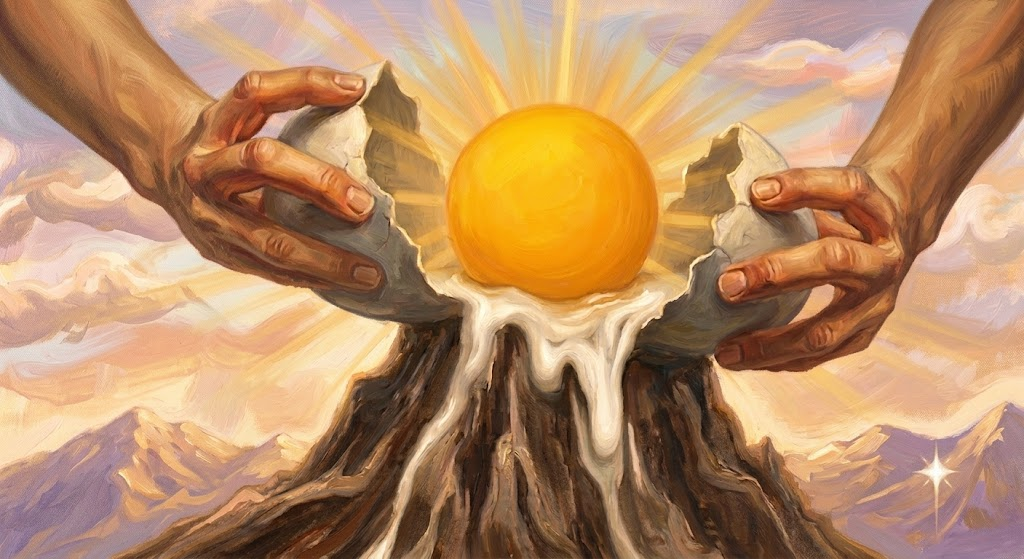
I started working on variations. I imagine that if were a painter I would have made a hundred versions of this, like Monet and his lilies or Hokusai and his waves.
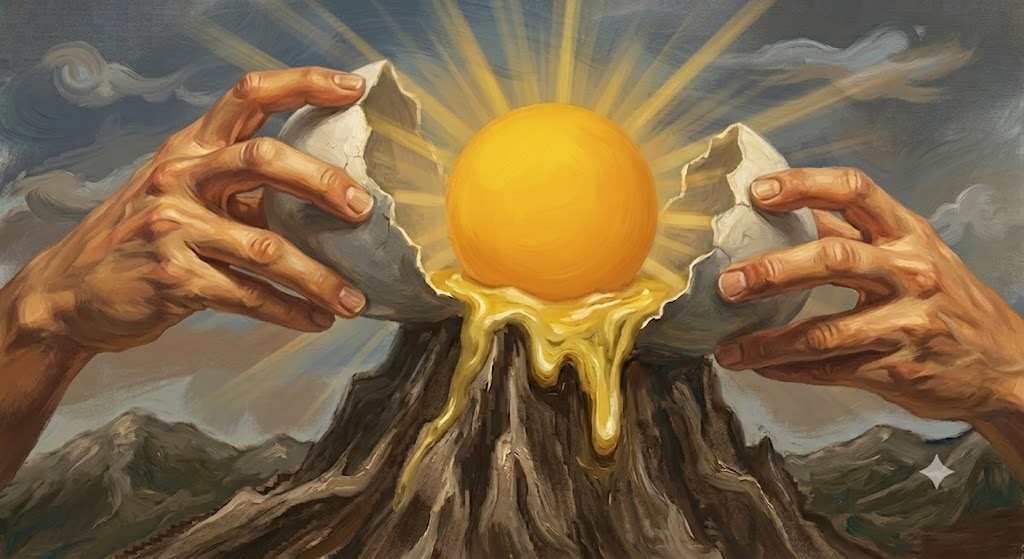
A thing I enjoyed – because I've never seen an image model do it before – is when Gemini changed her classic watermark (a simple four-pointed star in the bottom-right of every picture) into a bright shooting star with a long tail and little intercardinal rays. I feel like at that moment the model did something creative, congruent, unexpected and meta.
There's a legend – though I'm not sure it's precisely true – that the great Diego Velázquez didn't sign his paintings, as if to say "look at this work, look at these brushstrokes, who else but Velázquez could have done it?"
In one famous painting he put a little white piece of paper in the corner, as if it had accidentally blown up against a rock, in the place where the signature might have been.
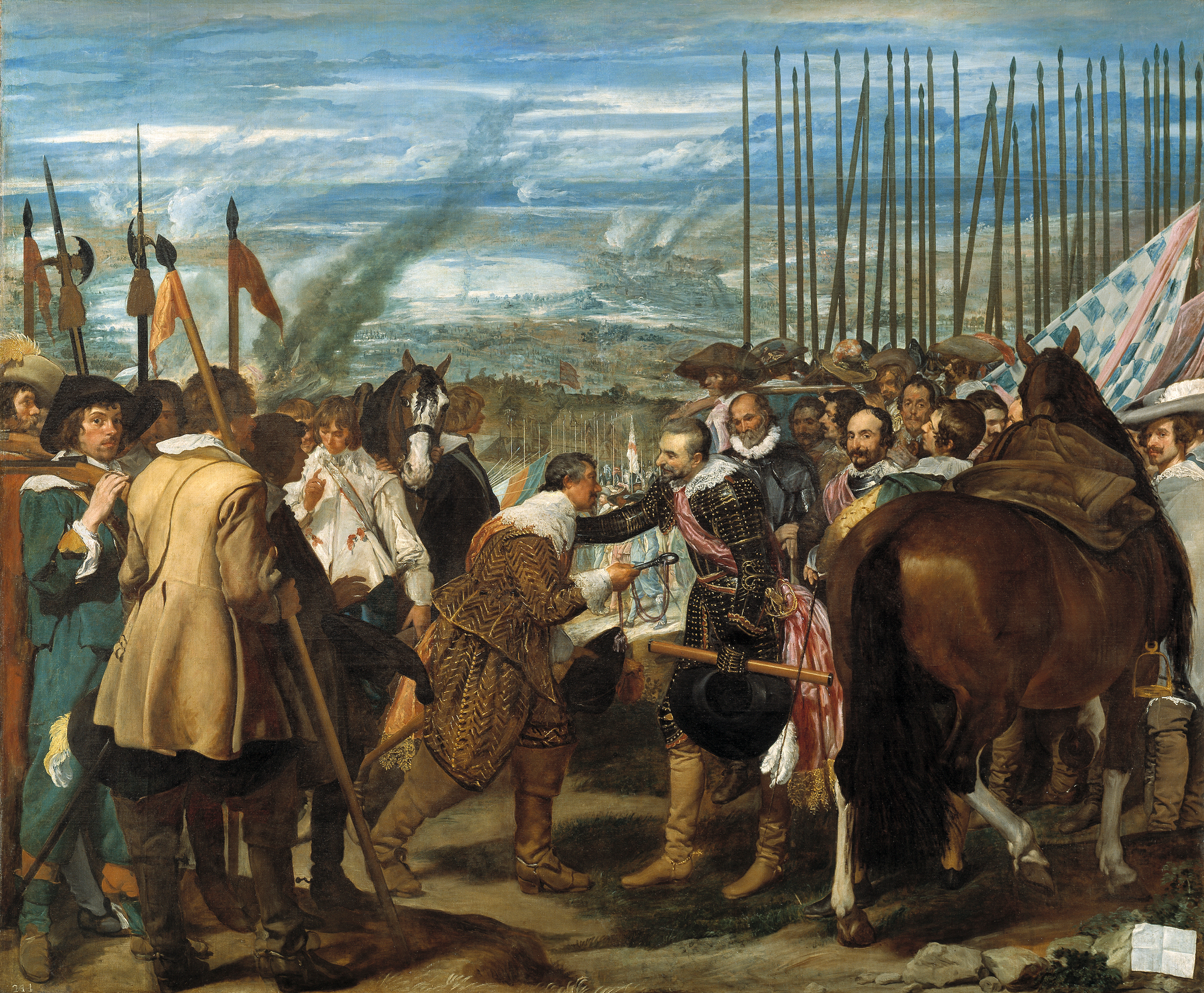
I don't have to tell you what that cartellino reminds me of.
Another story is that in Velázquez's time the artist was considered "merely" a manual laborer, and that his work was unsigned because a tradesman doesn't get to sign his work. It's funny how it could be both: you don't need to sign your work because you're so glorious no-one else could have done it, or you don't get to sign your work because you're considered too lowly to do so.