Newspapers Laundering Opinion
Just the facts
I worry a lot about Journalism: at its best it has a very important role in counterbalancing the big bears of Business and Government, and it's hard to see what else might fill that role in its absence. Orwell said that "journalism is printing something that someone does not want printed, everything else is public relations," and an obvious consequence of this is that powerful external parties will often want to disempower or circumvent journalism, to our collective peril. So I do believe that journalism is under basically-constant threat, and it feels bad to criticize a threatened body.
But many of the wounds on the body media are self-inflicted, and I think that the more external enemies you have, the more you should be careful not to damage yourself as well. So here is one way that I think modern journalism is hurting itself: I think it's really bad how much modern newspapers launder opinion as fact, and I think it's under-remarked because we generally read newspapers whose opinions-laundered-as-facts are agreeable to us.
Here are the top headlines from today's edition of a major newspaper:
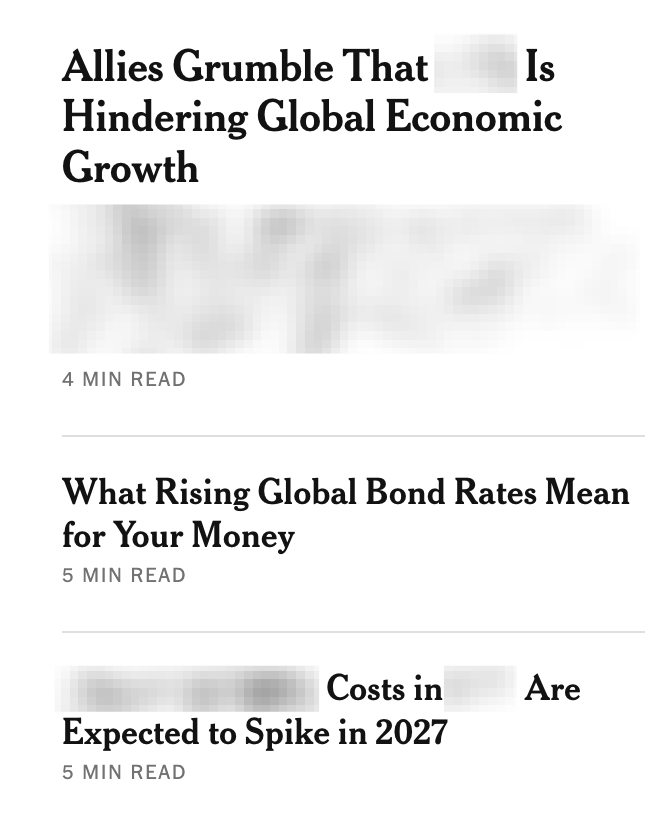
I censored the specific names in this because I think if you see them it's too easy to evaluate on a subjective basis: if I hate X, and the headline says Allies Grumble About X, it's easy to side with it. But I think this is wrong: "Allies Grumble" is simply not a meaningfully objective news headline in almost-any situation. For almost-anyone doing almost-anything there are at least some allies grumbling about it, and the choice to write a lead story about it is extremely selective and opinionated.
I think what this newspaper actually wants to say is We Believe X Is Hindering Global Economic Growth, but that doesn't fit with their self-conception as an outlet for objective reporting, so instead they find someone else who believes the same thing and report on that belief as if impartially.
Every time I see a headline that ends in experts say I want to tear my eyes out: either the thing the experts say is objective fact, and then you don't need the attribution, or (more often) the thing your experts said is an opinion, and should be an opinion column.
On this random day, three out of three of the top headlines are opinions: aside from Allies Grumble we have Costs Are Expected To Spike in 2027. This is not a fact, it's a collection of opinions: I could just about defend it if a newspaper had one consistent polling metric it used, and reported every month on what that metric said whether it's positive or negative or neutral (or every time it moved by a certain amount, or some other objective measure). But this headline is about an arbitrary poll run by one specific company, and if you read to the bottom it turns out it's "preliminary results" that will be updated later in the year (unmentioned further up the piece).
The only honest headline of the set, to me, is What Rising Global Bond Rates Mean For Your Money. This is also opinion!, to be clear, but I think it's clearly framed that way, even if in an authoritative-opinion style. But it's not attempting to convince the reader that this thing we both believe is objective reported news.
As I understand it, there's interesting historical reasons why newspapers try to claim a mantle of objectivity; it wasn't always the case, and in some countries newspapers were historically explicitly aligned with political parties, as in some countries TV news outlets are more straightforwardly partisan while newspapers try to claim neutrality. I think it's absolutely fine to have an opinion, and I understand that as people we are kind of inclined to think of many of our opinions as near-facts. But I think it's important to maintain the distinction, and that newspapers are doing a disservice to their readers by reporting on someone's opinion to launder it into the news section. A building collapsing is news; who is to blame for shoddy building standards is opinion, no matter how many of us share that opinion.