Imagined Communities
Many thanks to all of you who kindly responded to my survey earlier this week about communities. Here were the questions:
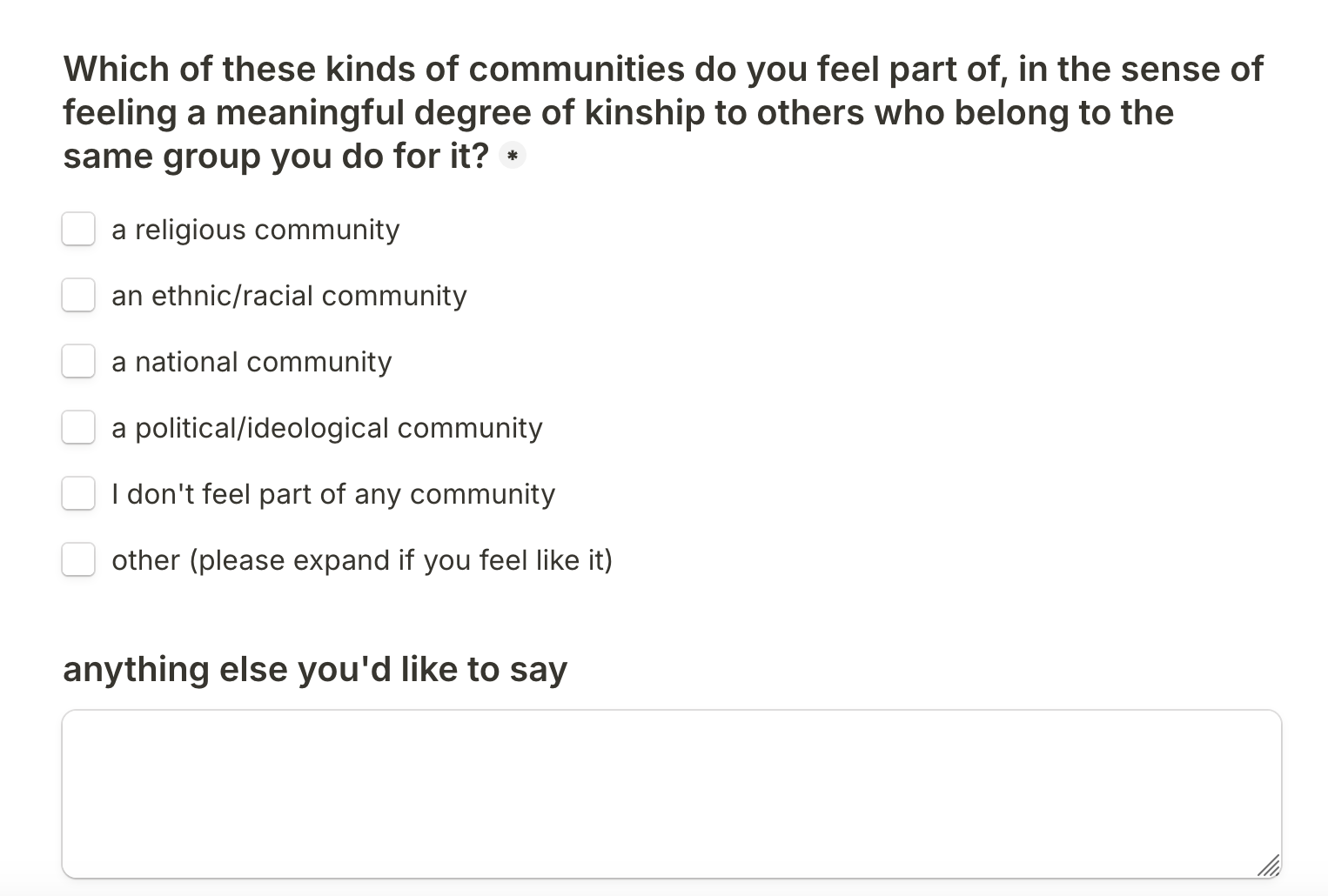
(An early version of the survey failed to include "no communities", sorry for those who responded early).
The motivation for this survey was a thought that's chased me around for years, namely: In Imagined Communities, Benedict Anderson claims that newspapers created national identity.[^1]
Specifically, the development of print capitalism meant that suddenly people across the country were reading the same words over their tea and coffee in the morning, and (per Anderson) this massive shared ritual created a sense of kinship across millions of people who would never actually meet each other, therefore creating the modern sense of a nation: an imagined community, because most of the members are strangers, but no less real for being constructed.[^2]
If you've existed in the modern discourse sphere over the last 20 years, you've possibly already had the same thought I did: if newspapers are dying, and (supposedly) we each exist in our own social media echo chamber, do we still have that imagined community? Does Anderson's model provide a framework for the fracture of our polities: we stopped reading the same newspapers over breakfast, so we stopped feeling kinship with our fellow citizens?
Of course, you may also have had the thought "wait weren't there multiple competing newspapers, often aligned with different ideologies" and also "when Anderson talks about this imagined community, was he actually just talking about property owning men of the time, really?", two valid questions which Anderson may or may not answer in the book, it's been a really long time since I read it and I don't remember, sorry.
Also, thinking about it, it's not obvious if the implication of going from "each country reads its own newspapers" to "everyone in the world is using five giant websites filled with screenshots of each other" would lead to more fragmentation, rather than less.[^3] Couldn't Twitter in theory bring everyone together, since we're all reading the same platform every day?
Anyhow. I don't actually have a thesis, but I can at least bring you the results of my survey; here's the types of communities ATVBT readers [^4] feel meaningfully a part of:
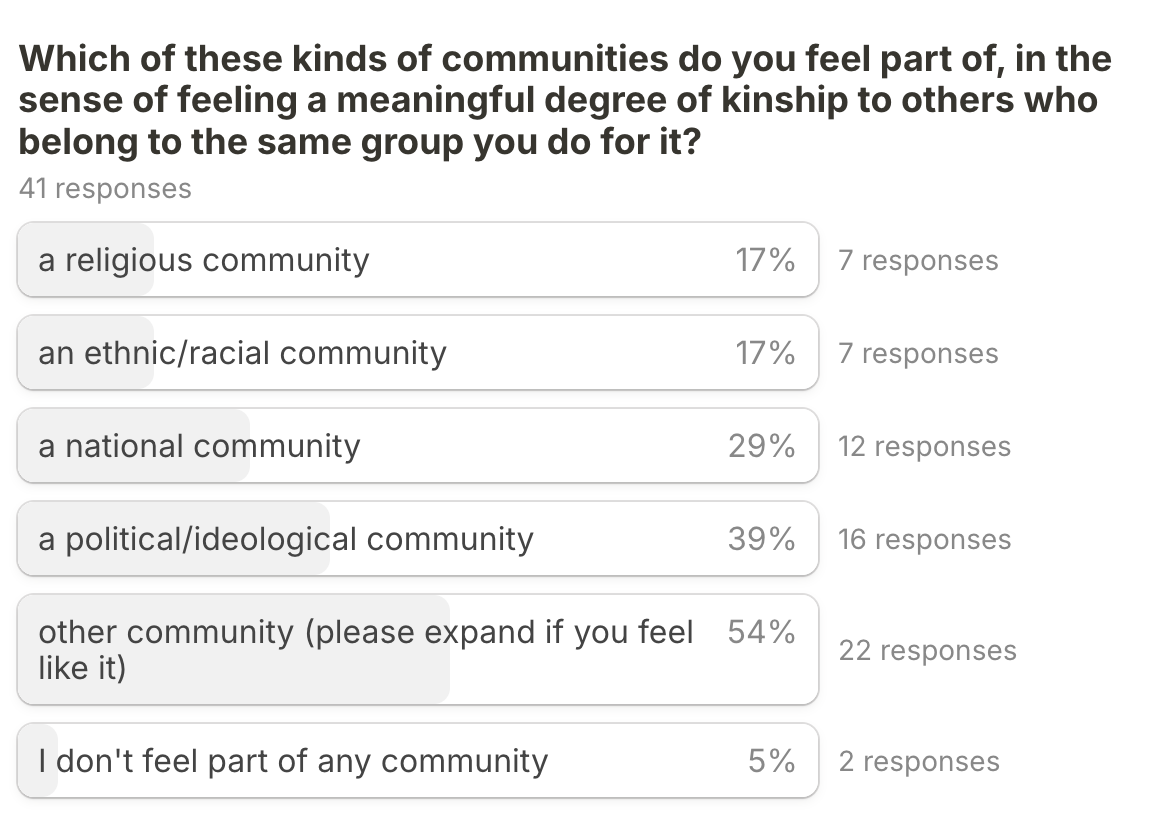
My main note is that "political/ideological community" has the most votes. Which doesn't really surprise me, because in my circles I would guess some form of political alignment is the strongly-held identity I most commonly encounter.
Here are some selected quotes of what you all had to say about your communities. I made the survey anonymous so everyone could feel at ease, but if you want to follow up by email please do, I would love to hear more about so many of these responses. I don't have any theories from them, but if you do please do throw down in the comments....
People who care about internal experience in a similar way to how I do
My "other" includes two others:
1. Community of visual artists in my local community and also stretching back through history.
2. Community of people with neurodivergence and learning disabilities.
alas, it is effective altruism
Odd that class is missing. Is it too gauche to admit it? Yes, but this is anonymous so: I (unironically) identify with rootless semi-neoliberal globalists.
Separately, I also feel kinship with people trained in quantitative methods (e.g. economists, engineers, physicists). Quants vs non-quants is an under-appreciated cultural divide. I am not a STEMlord*; it just functions like the options above in that we see the world in similar ways. * I am especially not a “rationalist.” They’re mostly quant cosplayers.
I feel kinship toward the Jewish community even though I don’t practice the religion as a result. It’s more a cultural kinship than religious.
I feel a kinship with people from my home state (CT), I think mostly because I don’t live anywhere near it anymore so it’s rare to meet someone else from there. Almost like being an expat.
I also feel kinship toward supporters of some sports teams I support (go Mets!), possibly for similar expat-esque reasons.
It seems to be when I’m in a minority, I feel more kinship with people in that minority with me.
A sober community (alcohol free, other than AA)
Community of literature lovers
Brown Women
Hate to say it but financial or work peer group is also my community because we have the same or similar lived experiences in the past 10-20 years
Well, to be honest, none of the above or any other not in this list! And it’s taken a ton of careful effort to get to this point.
[^1]: Assume all my claims about what Anderson does or doesn't say are kinda rough, it's been 15 years since I read the book. I tried to re-read it in order to write this post, actually about a year ago, and kept failing to do it for so long that I've given up and just decided to write this without re-reading him, sorry.
[^2]: not to get political on you, but one of his claims (as I recall it) is that many national conflicts involve people saying "the other side's national identity is imaginary, and therefore not real!", and Anderson's points are a) just because it's imagined doesn't make it fake, and b) your side's national identity is also imagined in the same way, you just don't realize it. [Of course, I'm sure he wasn't talking about YOUR national conflict!]
[^3]: I do greatly enjoy the "five giant websites filled with screenshots of each other" quote (h/t someone called Tom Eastman, apparently), and think of it often, but I also want to point out that it's not true: this is just the Western/American-sphere internet, and there are at least 2 other parallel ecosystems in the Russosphere and the Sinosphere where they use a different set of websites.
[^4]: or at least, those who filled out the survey, which was about 2/3 of those who clicked the link. Goes without saying that "readers of this blog" is not a representative sample of anything, but, you know what they say, you go to survey with the sample you have.