Estimating Land Areas Using Flight Times
works better than you'd think
Here's a trick I like to use when attempting to estimate land areas: planes fly at roughly 500 miles per hour. If you know roughly how many hours it takes to fly across a place, and roughly how long it takes to fly from top to bottom, you can estimate roughly how large the land mass is. For example:
The United States
Width:
- Flying from Boston to Seattle takes roughly 6 hours.
- 6 times 500 is 3000, so the US is roughly ~3000 miles wide.
Height:
- Flying from Seattle to Los Angeles takes roughly 2 hours.
- 2 times 500 is 1000, so the US is roughly ~1000 miles tall.
Size:
- 3000 times 1000 is 3 million, so the US is roughly 3 million square miles.
If you're an intelligent person then you'll have SO many objections to this. The US is not a rectangle! The earth is curved! Planes go slower at takeoff and landing! They don't even fly directly in a straight line! All these flight times and plane speeds are rounded!
This is all true, and yet the actual land area of the contiguous US is 3.12 million square miles. Somehow we ended up within 5% of the correct answer.
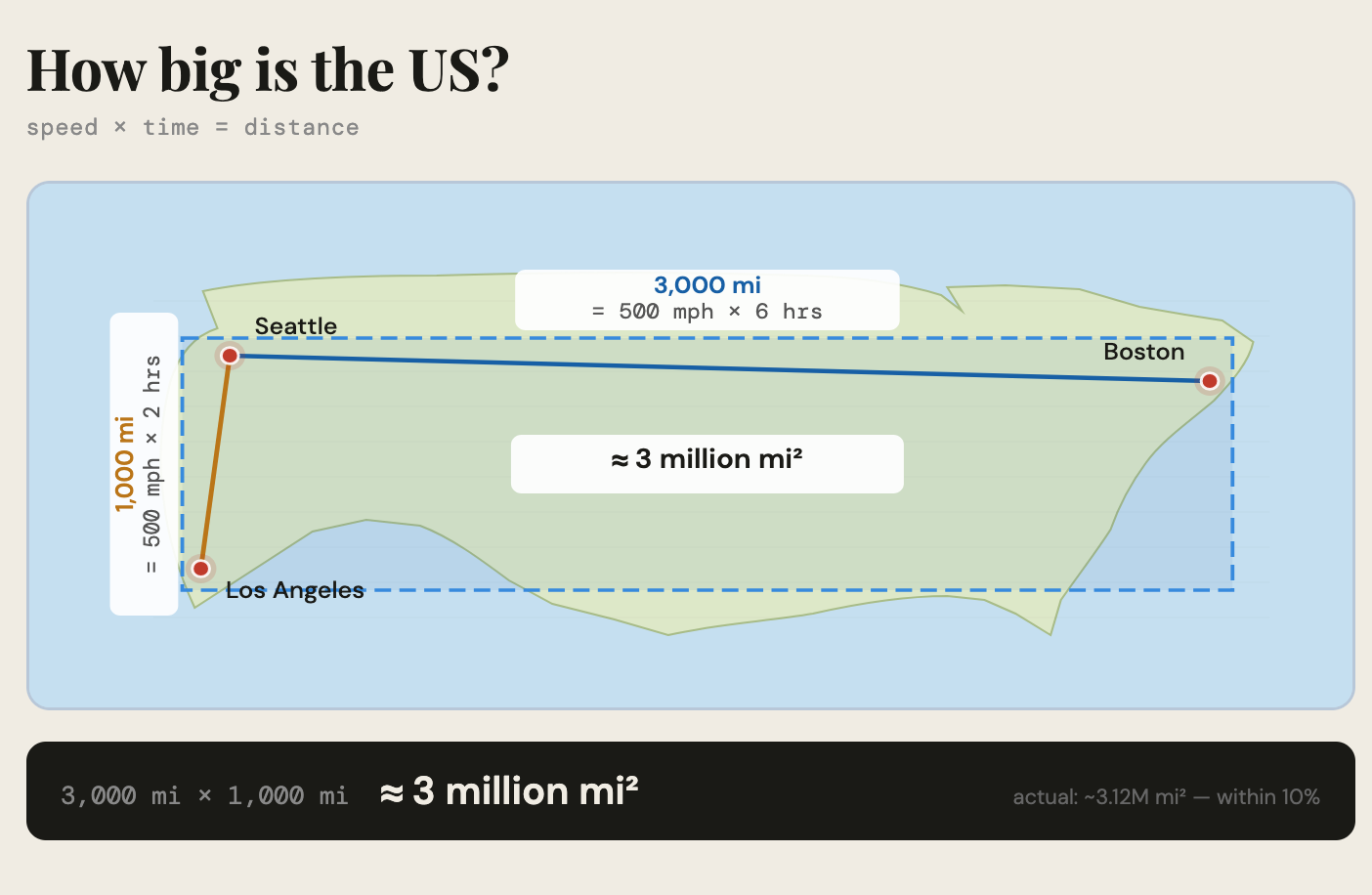
The "somehow" is that 1) a bunch of different simplifications cancelled out, 2) I got extremely lucky, 3) I am writing this article, if the calculation had come out badly I might not be writing it. In general I would be surprised if most calculations like this are even within 2x of the right solution. But having been to a few trivia nights where people are asked to guess the area of a land mass, most people left to their own devices don't know if the correct answer should end in "thousands" or "millions" or "billions", so this is an improvement.
Let's do some more.
China
- Beijing to Urumqi takes ~4 hours, 4 times 500 is 2000, so China is roughly ~2000 miles wide.
- Beijing to Shenzhen takes ~3 hours, so China is roughly ~1500 miles tall
- 2000 times 1500 is 3 million, so China is also roughly 3 million square miles.
In fact, China is 3.7 million square miles. It is even less of a rectangle than the contiguous US, and our rectangle didn't overlap the region correctly anyway. It doesn't matter! We're just trying to get a reasonable estimate, and we landed 25% off, which is pretty good.
If you'd picked different city pairs (or rounded differently) you might have said "5 hours across and 3 hours down" and then estimated 3.75 million square miles, which would have been spuriously exact; if you'd said "6 hours across and 4 hours down" you'd have estimated 6 million square miles, which is much less-good, but still within 2x of the right answer.
Africa
Africa is very obviously not a rectangle, even more so than the US or China. There's two ways to do this estimate: create two rectangles and calculate them separately, or try to fudge a rectangle that feels like the amount of ocean it wrongly includes might roughly balance out the amount of land it wrongly leaves out. Since I'm getting tired, let's do the latter.
- I know that flying from London to Cape Town takes 12 hours, so I'm guessing Cape Town to North Africa is 8-10? That would give a height of 4000-5000 square miles.
- So we're looking at 10 million to 12.5 million, with low confidence.
I think Nairobi to Lagos is 5 hours? That would give 2500 miles across. There's a lot of land west of Lagos (and some east of Nairobi), but will that balance out against the large amount of ocean that this rectangle covers? Intuitively I feel like it'll be an underestimate, but I don't have good intuition and I think the curvature of the earth / map skew around the equator might mess me up here.
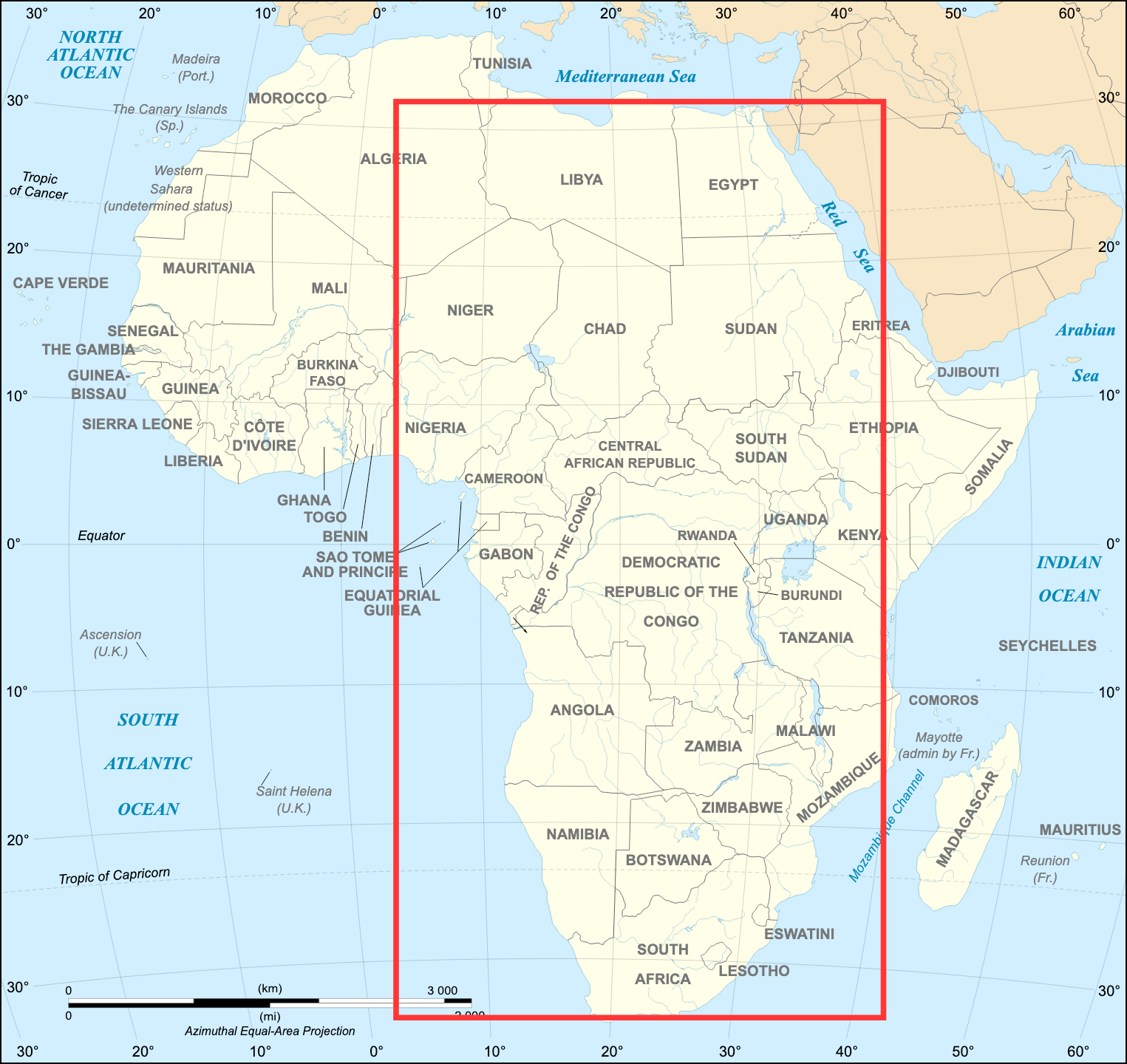
The correct answer is apparently 11.73 million, which is closer than I thought it would be, but also I got extra-extra-lucky here with the approximation working out. But again, I think if you can get within 2x of the answer here you've done pretty well.
I do want to re-emphasise that there's a lot of Researcher Degrees of Freedom with this blogpost, I might not have published it if it hadn't worked out so nicely, and therefore future estimates are unlikely to come out this close. Still, a fun technique; if you have others I'd love to hear about them.